


Joseph Lee & Company

© Ken Hawley Collection Trust - K.0538
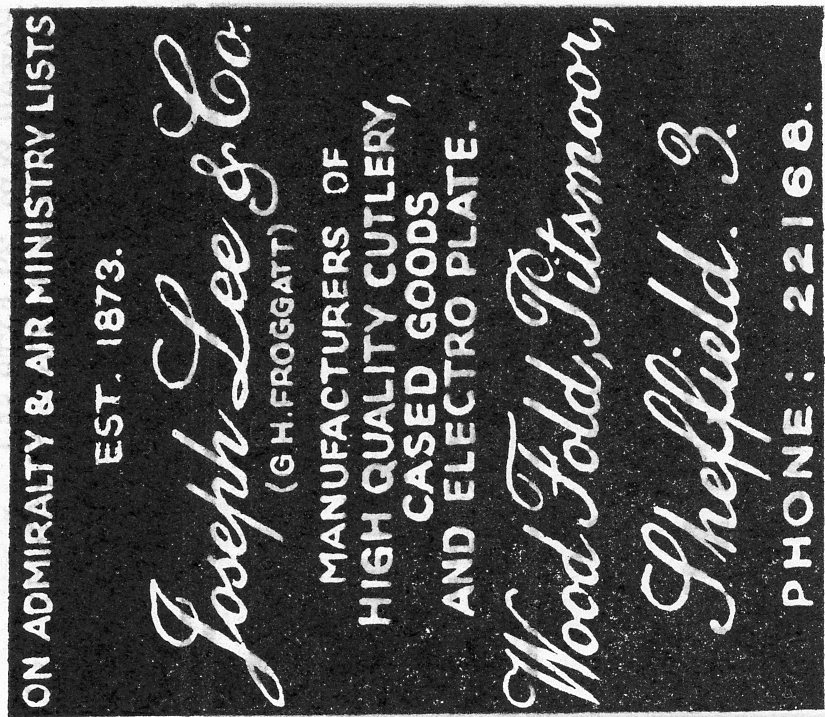
Joseph Lee (1846-1922) was a surgical and dental instrument manufacturer. He was born in Sheffield, the son of Joseph (a sheet roller). In 1841, the family lived in the Park distrrict. His father died when Joseph Jun. was a child and he was brought up by his mother, Emma, who had moved to the Pond Street district. Her family was involved in comb finishing, but by the age of fourteen Joseph was training as a surgical instrument maker.
Apparently, he launched his business in 1873. He formed Lee & Lambert in Cadman Lane, with Arthur Lambert (see George Johnson & Co). Lee told the Census in 1881 that he employed twenty hands. Lee & Lambert ended in 1887 and later Joseph Lee & Co, surgical and dental instrument manufacturer, was established at 45 Matilda Street. The three-storey factory had forging shops, a grinding wheel and engine on the ground floor, with packing rooms, warehouse, and workshops on the floors above. Joseph lived with his wife, Theresa, and their family in Barton Road, Heeley. He died on 10 January 1922, aged 75, and after a service at Heeley church was cremated at Intake. He left £4,013.
In 1927, the machinery and tools of the Matilda Street business – besides the stock-in-trade (mostly dental forceps valued at about £1,500) – were offered for sale (Sheffield Daily Telegraph, 25 July 1927). The auction was crowded with buyers hoping to bid for the surgical instruments in odd lots. But in a ‘sensational’ last-minute deal one buyer bought up the whole of the effects, so that he could continue the business (Sheffield Daily Independent, 27 July 1927). That buyer was George Henry Froggatt (1882-1966).
Froggatt had been born in Sheffield into a working class family. His father, George, was a steel melter. By 1930, he had become one of the city’s ‘best known and most active citizens’ (‘Who’s Who in Sheffield’, Sheffield Daily Telegraph, 22 October 1930). His career was varied, to say the least. After apprenticeship as an engineer’s fitter and turner, he joined the army, served in the Boer War, and was later a bandsman in the Royal Marines. He worked next as a sub-postmaster at Attercliffe. He had an entrepreneurial streak. In 1911, he became a director of Eyam Mineral Works Ltd, which dealt in fire bricks, cement, and the extraction of minerals from flourspar (Derbyshire Courier, 24 October 1911). Other money-making schemes involved boxing promotion and organising whist drives. Apparently, the proceeds of these ventures enabled him to develop an interest in engineering and medicine. In 1912, he became an artificial teeth maker in Cambridge Street. In 1920, he registered as a dental surgeon, with his own practice in Carver Street. He became closely involved with the Dental School at Sheffield University and with the Royal Hospital. In particular, he developed an interest in stainless steel for dental instruments and plates. He was also a long-serving town councillor. In 1927, he bought Froggatt Edge, the well-known beauty spot from the Duke of Rutland, partly (it was said) because of a possible link with the family name.
Froggatt attributed his diverse career to being able as a young man to sleep alternate nights, using the wakeful night for study; and also claimed a photographic memory (Quality, November 1966). His personal life was eventful, too. In 1913, his wife, Edith Ellen, had been found lying in bed with her throat cut with a razor. A note beside her read: ‘I really cannot bear this torture any longer’ – apparently a reference to losing her mother a few weeks previously (Sheffield Daily Telegraph, 1 November 1913). In the following year, Eyam Mineral Works was liquidated. Froggatt’s attempts to raise funding by running whist drives led to a fine under the Gaming Act for unlawful gambling (Sheffield Daily Telegraph, 18 May 1915). He seems to have been an erratic driver. He once tried to sue Sheffield Corporation for hitting one of its waggons at night. He was in collision with a motor cycle and sidecar near Sheffield, which resulted in a fatality; though no blame was attached to Froggatt (Express, 9 June 1928). But on another occasion, he was fined and had his license suspended for six months for dangerous driving when drunk at Barlborough. Froggatt claimed that he had only had two whiskies (Derbyshire Times & Chesterfield Herald, 12 November 1937).
Froggatt presumably purchased the assets of Joseph Lee & Co, so that he could source dental and surgical instruments. He showed no interest in Lee’s former premises at 45 Matilda Street and these were offered for sale (Sheffield Daily Telegraph, 11 November 1927). Instead, in 1929 Froggatt purchased premises for Joseph Lee & Co at Emu Works, at the corner of Eyre Street and Matilda Street. This factory had been vacated by Ford & Medley. It was said that Froggatt moved so quickly on the purchase that the grinders, who had been thrown out of work in the grinding hull because of new regulations regarding grinding wheels, resumed work within a few days (Sheffield Daily Telegraph, 22 Au-gust 1929). Froggatt claimed that he had succeeded in a new method of making stainless alloys pliable and workable, so that they could be more easily manipulated for domestic articles, such as tankards, trinkets, fruit containers, and golf club shafts (Leeds Mercury, 21 July 1933).
In 1938, Froggatt offered for sale at auction Froggatt Edge; and also put Emu Works on the market (though the sale of the latter was withdrawn). In the following year, Froggatt accepted an offer for Froggatt Edge from the Council for the Preservation of Rural England, which gifted it to the National Trust. Froggatt’s industrial activities during the War are not known in detail, though it was said he continued to run his engineering firm and also became head of a company manufacturing light fittings (Quality, November 1966). By 1951 (after he had lost his town council seat), he was operating Joseph Lee & Co as a ‘high-class’ cutlery manufacturer at Wood Fold, Pitsmoor. Froggatt also owned Fiberloid, which had been based at that address since the 1920s. Both firms were vehicles for Froggatt’s experiments in designing and manufacturing table knives. He died at his home Froggatt Bungalow, Froggatt, Derbyshire, on 23 November 1966, aged 84. He left £20,628. Joseph Lee & Co and Fiberloid became defunct.