


Aaron Hatfield & Sons

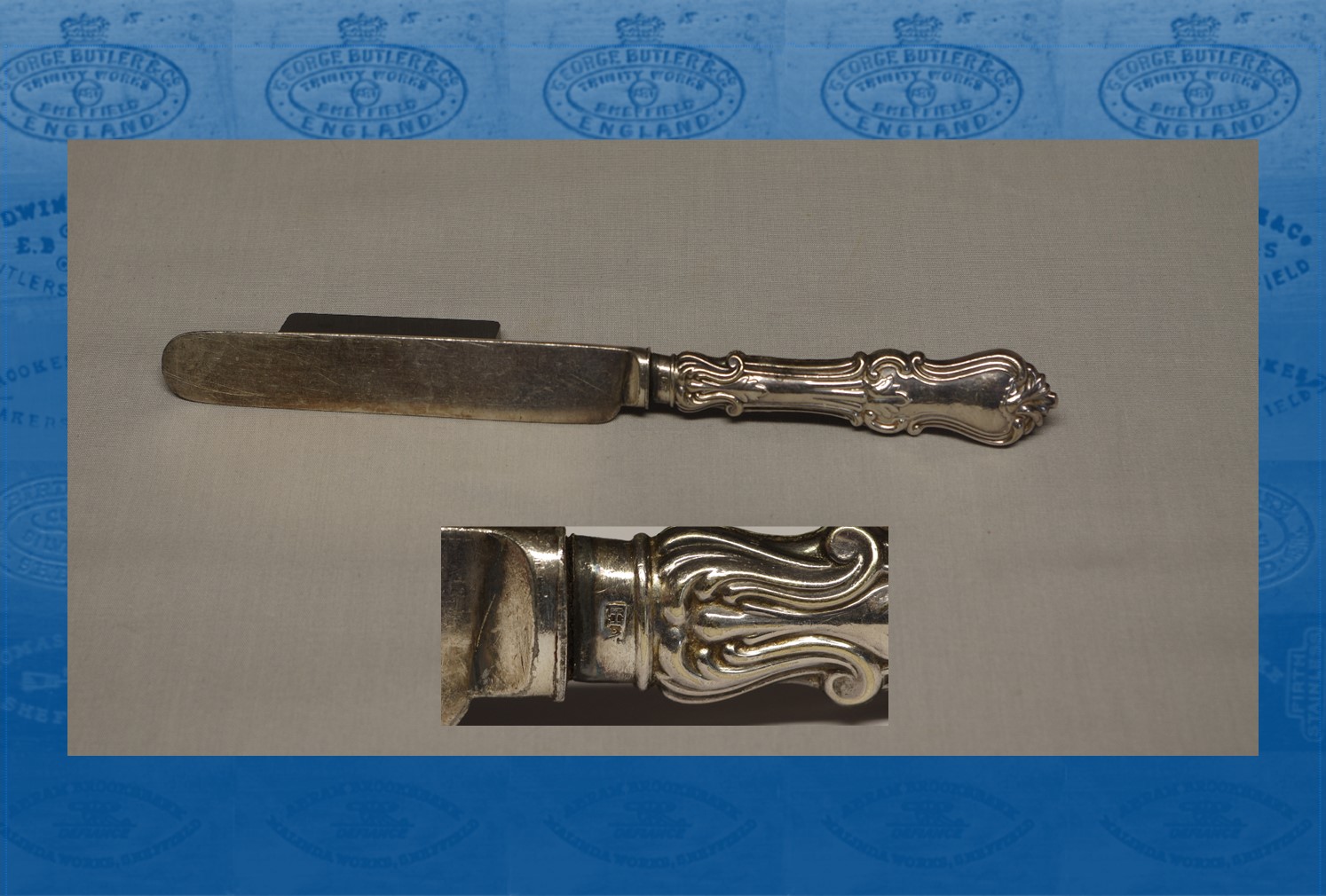
Silver mark. Image courtesy of Geoff Tweedale.
Aaron Hatfield (c.1763-1844) was originally an ivory and wood turner. He and his wife, Mary, had several children, including John (c.1796-1879) and William (1802-1871).
In 1808, Aaron registered a silver mark (AH*JH) as a close plater and silversmith in Pepper Alley (Bradbury, 19121). In a directory (1811), he was listed as a table knife, teapot handle and knob manufacturer, and dealer in cutlery, Fargate. Further silver marks were registered in 1818 (A·H) and in 1823, when the enterprise was styled as Aaron Hatfield & Sons in Pepper Alley. Table knives, and silver and plated cutlery, became Hatfield’s forte. According to Moore (20082), Hatfield ‘produced [silver fruit-knives] of the finest quality and is probably the most desirable maker [for collectors] from this time’.
In 1827, his son, William, withdrew from the business and by 1841 had become a silversmith in Manchester. John continued in the firm until the 1830s, but later became a partner in Neepsend Brewery. Aaron became wealthy and lived at Endcliffe Grange. He died there on 24 May 1844, aged 81, and was buried in St Paul’s churchyard. In 1818, Aaron’s daughter, Sarah, had married Richard Martin, a London silversmith. By 1849, Richard and Sarah’s sons – John Aaron and Richard – launched Martin Bros & Naylor, which absorbed Aaron Hatfield’s old business.
1 Bradbury, F., History of Old Sheffield Plate (London, 1912)
2 Moore, Simon, Pocket Fruit Knives: A Synopsis of Their History from the United Kingdom, France, Northern Europe and USA (Slough, 2008)