


Samuel Hancock & Sons

© SCC Picture Sheffield [y12236] - image from Sheffield and Neighbourhood (page 188 B) (printed and published by Pawson and Brailsford, Sheffield, 1889

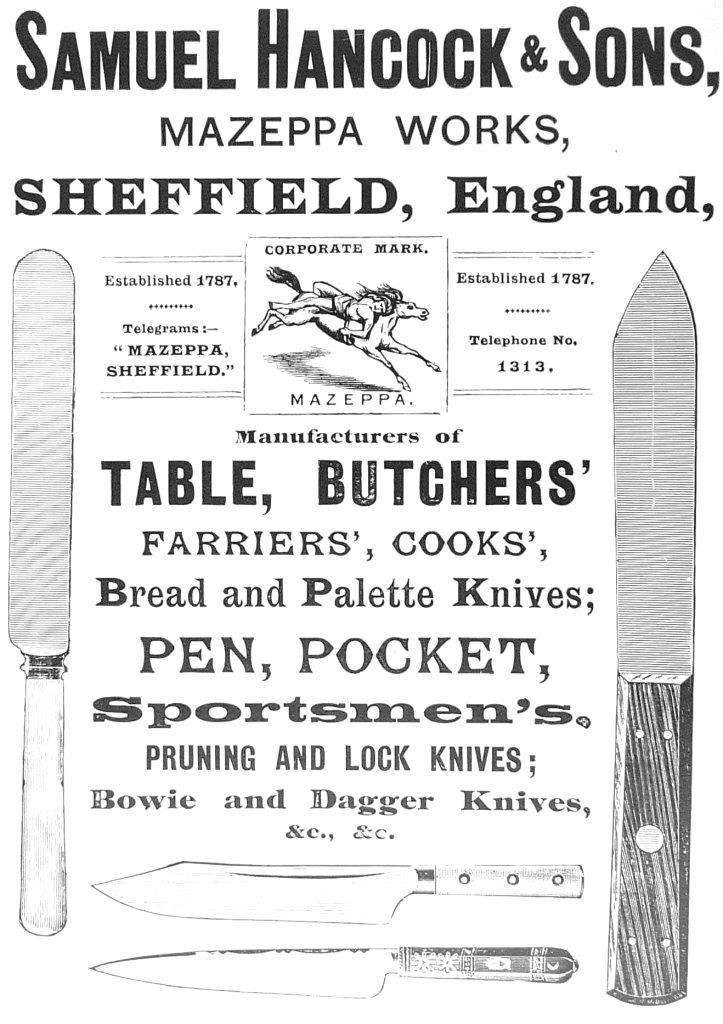
This firm had one of the most striking of nineteenth-century trade marks – ‘MAZEPPA. This was a reference to Ivan Mazeppa, a historical Cossack figure in Ukraine, who had been bound naked to a horse’s back as a punishment for adultery. Advertisements stated that the mark was first used in 1787. The business was started by Samuel Hancock (c.1795-1854), who in the 1841 census was a cutlery manufacturer in Pea Croft. In the 1820s and 1830s, he had combined pen knife and razor manufacture, with running a grocery shop. Samuel was probably one of the brothers (the other was Thomas Hancock), who operated Hancock Bros, cutlery manufacturers, Pea Croft. This was dissolved in 1842. By 1849, Samuel Hancock had become a pen and pocket knife manufacturer at Pea Croft Works. He was granted the Mazeppa mark in that year. In 1852, Samuel Hancock & Son was located at 45 Pea Croft, with Samuel residing in Northumberland Road and his son, Jonathan Smith Hancock (1820-1876), living in Broomhill.
Samuel Hancock, of Northumberland View, died, aged 59, at Broomhill Cottage (the residence of Mrs Smith) on 3 May 1854. He was interred in the General Cemetery. Jonathan took over the business, which was restyled ‘& Sons’, with the addition of his brother, Samuel (1832-1889). According to the Census, Hancock’s employed fifteen men and two girls. A business review described its products as ‘pen, pocket, sportsman’s, sailors’, farriers’, castrator, strike, fire, spear, bowie, dagger, vine and Spanish lock knives, pen machines, butchers’, curriers’, cooks’, bread and palette knives, spoon knives, picnic cases, razors, etc.’ In 1863, Jonathan and Samuel registered a preliminary patent for an ‘improvement’ in anti-garrotte knives. Under the headline, ‘Garotters Look Out’, a newspaper described the Hancock weapon as pocketable, with blades at each end, and a foot in length when opened (Sheffield Daily Telegraph, 6 December 1862).
The company advertised regularly in local directories and used the image of Mazeppa to good effect. South America was evidently an important market, where the Mazeppa mark was well known enough to be imitated by other Sheffield manufacturers, such as Joseph Fenton & Sons (Sheffield Independent, 23 February 1861). The business made a comfortable living for the owners: Samuel lived at Stoneleigh Villa, Crescent Road; and Jonathan in Lawson Road. The latter died on 23 August 1876, aged 55. He was buried in Fulwood, leaving about £3,000. The finished stock of Pea Croft Works (including 5,000 dozens of spring knives) was sold. Under Samuel, the firm moved first to Mazeppa Works, Sycamore Street; and then in 1880 to Button Lane. Samuel’s staff was now only one man and a woman. The newspapers recorded his death on 25 January 1889, aged 56, after ‘a long and painful illness’. Samuel was buried in the General Cemetery and left £1,873.
The business was operated next by Harry Hancock (Jonathan’s son) and Charles Rickett (who retired in 1892). In 1891, the firm issued a grovelling apology to Albert Oates for stamping his ‘AOT’ mark on cutlery, supposedly at the request of a Birmingham merchant (Sheffield Daily Telegraph, 10 January 1891). In 1896, the Hancock name and Mazeppa mark passed to Reuss & Co. Hancock’s, now based at Charlotte Street, became the manufacturing side of the Reuss business.