


F. G. Gill & Sons / G. W. Gill Ltd

Advertisement from 1921. Image courtesy of Geoff Tweedale
Frederick George Gill (c.1856-1929) was a spring-knife cutler, who had been born at Heeley. His wife was Isabelle (d.1926). In 1902, his working address was Backfields, but within a couple of years it was Division Street. The trading name was F. G. Gill & Sons. George William, John Henry, and Fred were the sons. During the First World War, F. G. Gill & Son was listed at 104 (back of) West Street, with George William (1889-1974) helping his father. By 1919, Frederick had moved to Bailey Lane, where he manufactured tin openers. By the end of the 1920s (when the firm was again styled F. G. Gill & Sons), he was producing putty knives at Bailey Lane and Penton Street. Frederick George Gill was buried at Burngreave Cemetery on 1 October 1929 after his death at 195 Petre Street.
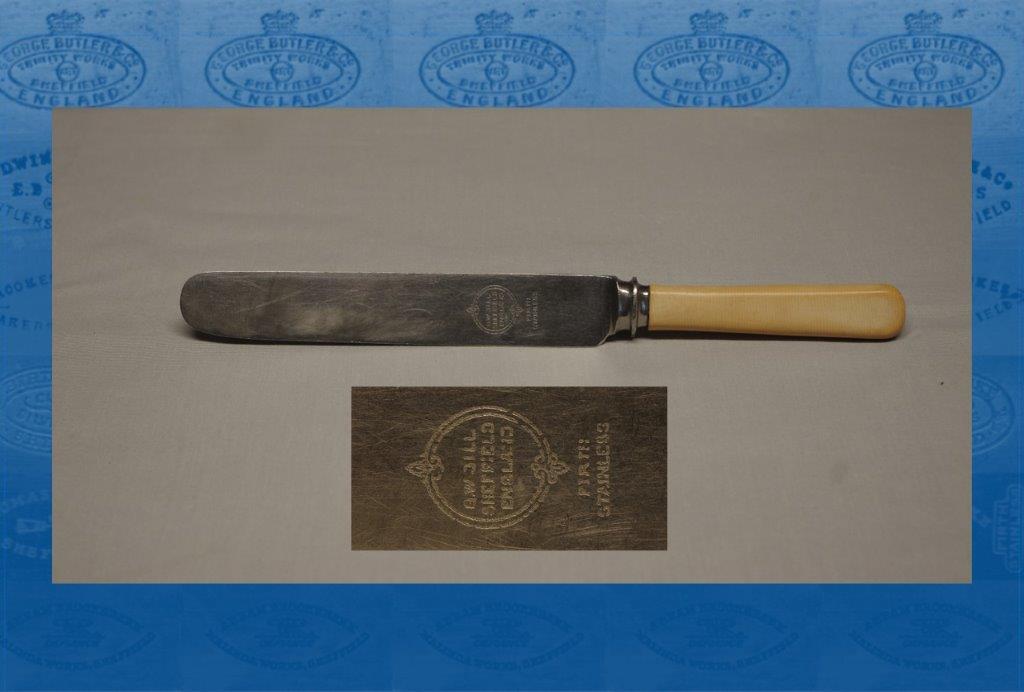
In 1919, his son, George William Gill, was listed as a cutlery manufacturer at Central Works, 100 West Street. In 1920, he registered G. W. Gill Ltd as a private limited company, with £6,000 capital. His accountant, Percy Toothill, was listed as a subscriber. In 1921, Gill (who claimed ‘35 Years’ Reputation’) advertised a game pocket knife of his own design. He also introduced an electrician’s knife, with a hand-forged blade and two spanners. Razors, stainless table cutlery, and electro-plated goods were also advertised. Presumably, most of these products would have been factored. Gill relied on borrowing to launch his business, but when trade turned sour the debenture holders ordered the sale of the business. It was offered as a ‘going concern’ and ‘well-equipped business’ at West Street, Rockingham Street, and Penton Street.
In 1925, the firm, which was still trading (but not as a limited company), was hit by a fire. In that year, the Sheffield directory listed George William Gill (Penton Aluminium Co) as an aluminium handle manufacturer. One of his advertisements in 1922 had shown a metal-handled table knife, so this may have been a new venture. However, in the following year, Gill was fined £5 and had his licence suspended for a year, after he was found drunk in charge of a vehicle in Trippett Lane (Sheffield Daily Telegraph, 7 July 1926). A few months later he appealed, but the court rejected his claim that he was now sober. In 1927, he was insolvent with £565 liabilities, which he blamed on the coal strike and bad debts. His subsequent life and career have been difficult to trace.