


George Johnson & Son / Ann Johnson & Sons / George Johnson & Company

Advertisement from 1889; Picture Sheffield (y11994) © SCC
George Johnson (c.1758- 1818) was variously described in baptismal registers as a cutler or razor smith. He may have been the son of Edward Johnson, a shoemaker (if so, he was baptised on 22 January 1758). George and his wife, Ann (c.1763- 1828), had at least seven children. These included two daughters – Elizabeth (bapt. 1790- 1836) and Frances (1807- 1847) – and five sons: George (bapt.1785- 1867), James (bapt.1786- 1832), Edward (c.1791- 1807), William (bapt.1793- 1841), and Charles (1794- 1851).
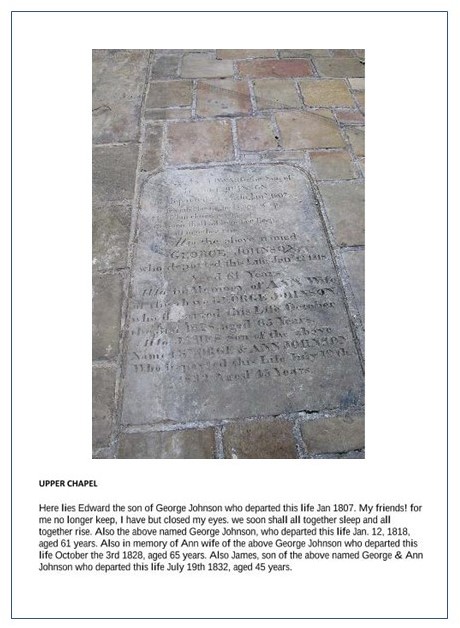
George Johnson (presumably this razor maker) was in partnership with William Sayles, until they separated in 1791. He may have also been in partnership with William Harwood. In 1816, George Johnson & Son was listed in Furnival Street as a maker of razors and desk and pen knives. George Jun. was presumably the ‘Son’. However, George Sen. died on 12 January 1818, aged 61. His gravestone can be seen in the courtyard of Upper [Unitarian] Chapel, Norfolk Street. The business (in which Ann and her son, George, were partners) was restyled George Johnson & Co, table knife, razor and lancet maker, Furnival Street.
In 1823, the Furnival Street premises (‘workshops, warehouses, and other buildings and conveniences in yard adjoining’) were auctioned by Ann (Sheffield Independent, 15 November 1823). These had housed George Johnson & Son and its successor George Johnson & Co. Ann and George dissolved their partnership. Ann Johnson & Sons was next listed in Furnival Street as a manufacturer of table knives and surgeon’s instruments. Ann died on 3 October 1828, aged 65, ‘after a long and protracted illness’ (Sheffield Independent, 4 October 1828). Her burial was also at Upper Chapel.
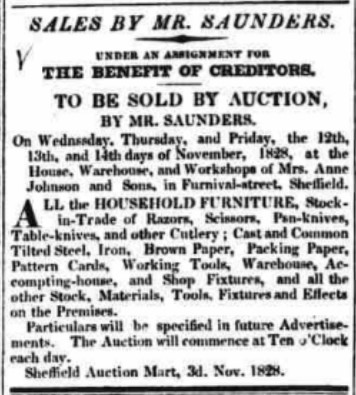
Ann’s partners, sons James and Charles, promptly dissolved the business to pay creditors (Sheffield Independent, 11 October 1828). James died on 18 July 1832, aged 45, and was buried at Upper Chapel. Charles continued to trade in Eyre Lane, almost opposite to W. & S. Butcher. In January 1832, he married Maria Holmes at St Bride’s Church, Fleet Street, in London. Charles auctioned his stock of table knives and razors, besides his working tools (Sheffield Independent , 5 May 1832). In June 1832, Charles and Maria landed in Philadelphia, with ‘seven boxes, two bags, one baize package’ – presumably their worldly goods. Charles became a saw maker and in the 1830s partnered his younger brother, William. Charles taught Henry Disston, who was destined to become America’s most prominent saw manufacturer. William died on 18 June 1841, aged 48, and was buried at Christ Church Burial Ground in Philadelphia. Charles sold out to Disston, though he later became a partner in Johnson & Conaway, another Philadelphia saw maker. Charles died in Philadelphia on 20 October 1851, aged 57, from a liver complaint. He was buried at Odd Fellows Burial Ground, Philadelphia.
In Sheffield, George Jun. had continued as George Johnson & Co. In 1825, the firm was listed in the local directory at Tudor Street, ‘near the Theatre’. By 1837, it had relocated to Porter Street, from where over the next forty years it made and sold table knives, razors, and lancets. George and his wife, Mary, had (according to General Cemetery registers) four sons between 1817 and 1822: Edward Sidney, George, Joseph, and Robert Henry. The latter, a ‘razor manufacturer’, died prematurely, aged 23, on 1 March 1846 from ‘decease [sic] on the chest’.
George Johnson died on 5 March 1867, aged 81 (four years after his wife). He left a fortune approaching £6,000 (£670,000 at 2019 prices). George Johnson, his son and successor in the business, died on 10 April 1880, aged 61. His brother found him dead in bed one morning at Clinton Place, Broomhall Street. The cause was ‘rheumatic gout' (Sheffield Daily Telegraph , 12 April 1880; Sheffield Independent , 17 April 1880). Edward Sidney Johnson, ‘gentleman’, of Milton Lane, died on 9 January 1887, aged 69. Joseph Johnson, ‘gentleman’, Glover Road, died on 9 December 1889, aged 70. The burials in the General Cemetery were unconsecrated (except for Robert’s).
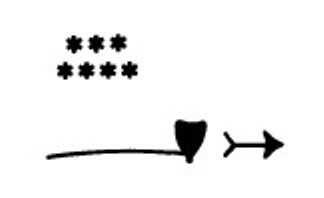
The Johnson marks were seven stars (granted 1835) and a pipe and dart device (granted 1698). In 1887, the pipe and dart – which George Johnson had purchased in 1842 for £35 from Thomas Linley – had been sold by his son Joseph to Arthur Lambert (1843- 1910). The latter was the son of a horn comb cutter. Arthur Lambert became a surgical instrument maker, who had earlier partnered Joseph Lee, but by 1881 was living next door to Joseph Johnson in Highfield Place. This connection presumably led to Lambert trading as ‘George Johnson & Co’. In 1888, George Wostenholm & Son took Lambert to court, because of the alleged similarity of the pipe and dart to Wostenholm’s ‘pipe’ brand. Wostenholm’s lost (Sheffield Independent, 21 July 1888; 25 March 1889).
By 1895, George Johnson & Co was a razor and cutlery manufacturer in Union Lane and Porter Street; then in 1898 in Norfolk Lane. It disappeared from directories in about 1904. Arthur Lambert lived in Wostenholm Road. He died on 16 October 1910, aged 67, leaving £152.