


Sanders & Bowers Ltd

Albert Sanders snr, c1901, aged 21. Photograph courtesy of Richard & Catherine Sanders (grandson of Albert)
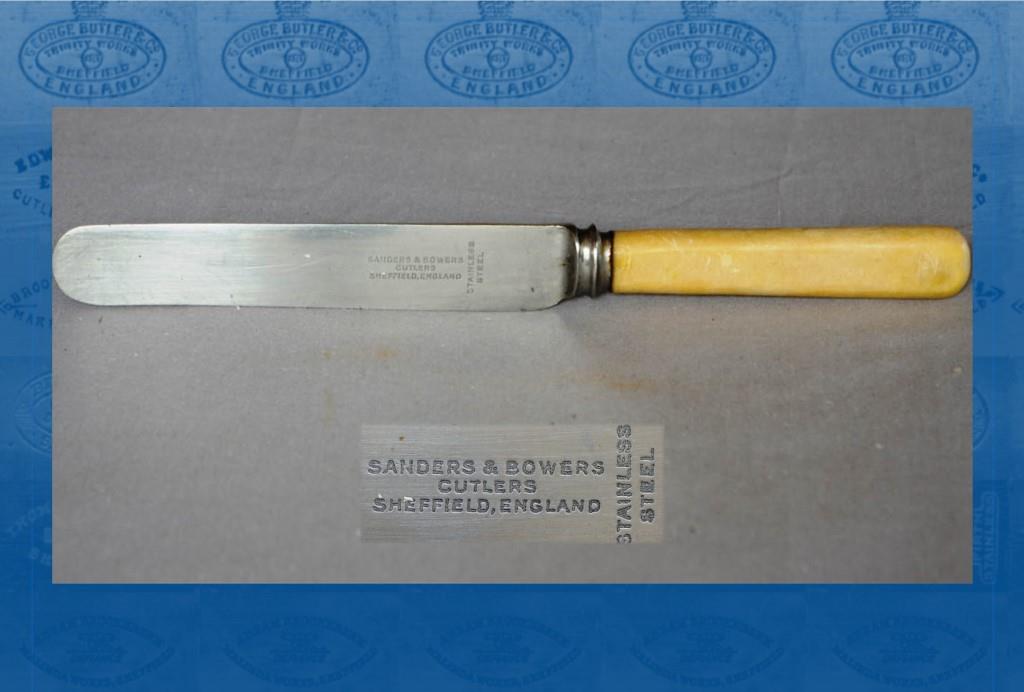
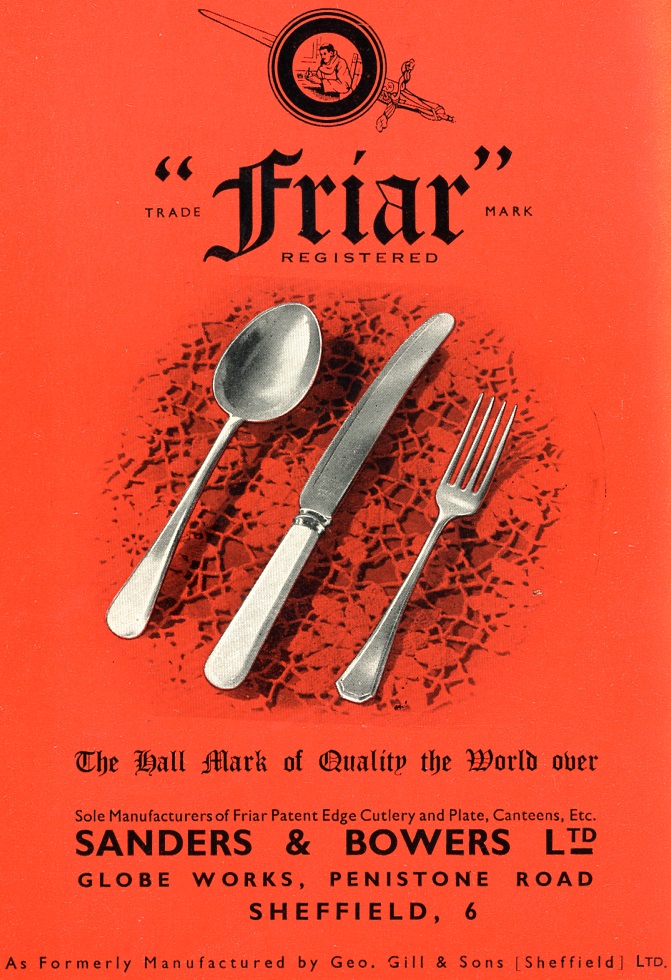
This cutlery manufacturer was well known for its ‘FRIAR’ knives, which were marketed between the 1950s and 1970s. The firm can be traced to the Sanders family, which came from Birmingham. James Sanders (c.1818-1885) was born at Perry Barr, Staffordshire, and was originally a button maker. In 1839, he married Martha née Wood at Harborne. In the Census (1841), James and Martha were living with their son, Joseph (1839-1875) at Nechells Road, Aston, on the outskirts of Birmingham. In the early 1840s, they moved to Sheffield. But Martha died in 1845, aged 28, and was buried at St John’s churchyard, Park. In 1849, James married Sabina Summers at Rotherham Parish Church. In 1851, they were living at Saville Street, Sheffield. James was working as a pearl turner. By the following decade, he was a railway spring maker – possibly working for one of the nearby steel firms, such as John Brown & Co. His son, Joseph, had followed him into the trade, but he died in 1875. James died on 2 January 1885, aged 66. Father and son were buried in a family grave at Burngreave.
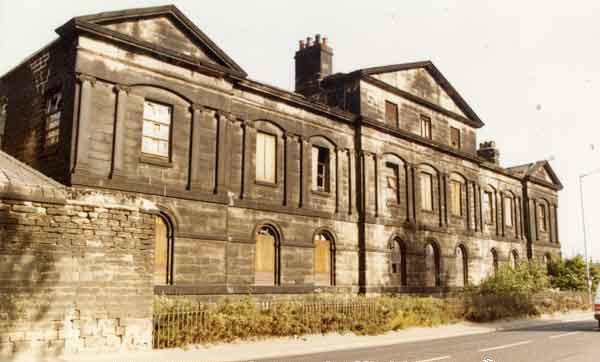
Joseph had married Elizabeth Broomhead in 1865. Their son, James Sanders (1865-1930), became a table blade grinder. He lived at Pitsmoor with his wife, Elizabeth Ann née Keys, and their son Albert (1887-1954). In the Census (1911), James was a table blade grinder, on his ‘own account’; Albert was also grinding table knife blades. By 1925, Albert had started business as a cutlery manufacturer at Globe Works, Penistone Road (near the present Kelham Island Museum). His output included table knives marked ‘Firth Stainless’.
James Sanders died on 25 June 1930, leaving £192. He was buried at the parish church, though his remains were later removed to Burngreave. In the following year, Sanders & Bowers was formed. Albert’s partner was Charles William Bowers (1871-1940), who had been born in Norfolk, the son of William and his wife, Susan. The family was living in Sheffield by 1891, where William was a general labourer and his son was a warehouse man. By 1911, Charles William was a cutlery manager. His spell with Albert Sanders, however, only lasted a year or so. In 1932, Bowers left the partnership. He died on 27 March 1940 and was cremated at City Road, leaving £229.
Albert Sanders’ sons – Albert Jun. (1912-1996), Ronald (1917-1997), and Frank Anthony (1925-1999) – joined him at Globe Works. The business became a private limited company in 1947, with £3,000 capital. The prospectus described the output as stainless cutlery, electro-plate, cased goods, spoons, forks, and pen knives. In the following year, when George Gill & Sons was liquidated, the Sanders acquired its ‘FRIAR’ trade mark and the rights to its patented serrated knife (which was re-registered). In 1953, Ron Sanders applied for an American patent for the design in the USA (which was granted in 1956). He claimed that the fine grooves (flutes) along the edge of the blade gave the same ‘feel’ as an ordinary blade, except that it was much sharper. Moreover, ‘because of the shallowness of the grooves and the absence of a saw-like character in the actual cutting edge, the blade may be washed and cleaned much as in a normal blade’ (US Patent 2,760,266).
An important role in the company was played by Cyril Bishop (1909-1976), whose descendants had founded George Bishop & Sons. Cyril became a director at Sanders & Bowers. Albert Sen. died on 2 June 1954, leaving £5,766. His grave is in unconsecrated ground at Crookes Cemetery. Albert’s grandson, Richard, joined the firm in 1960.
In the 1950s and 1960s, the firm manufactured a range of ‘Friar’ kitchen knives, including steak knives with wooden handles; knives and forks with rainbow-coloured handles; ‘snips’ (scissors with a ‘Friar’ edge); and also a knife sharpener. Cutlery canteens and presentation carving sets were also marketed. Some of the boxes of table cutlery were marked, ‘Cutlers since 1868’, but this was a fiction. By the 1960s, the firm had added two silverware patterns, ‘Beauchief Abbey’ and ‘Fountains Abbey’. The range of products can be seen in the firm’s ‘Cutlery Catalogue of Friar Plate’, printed in 1961 (a copy is at Sheffield Local Studies Library). Sanders & Bowers enjoyed an international trade, particularly with the USA.
Cyril Bishop died on 30 June 1976, leaving £3,246. At about this time, the business was winding down, partly because of Far Eastern competition, but also because Globe Works was about to close (at one point, in the early 1970s, it was scheduled for demolition). The company, though, had a suitor. This was John Price (see Arthur Price), who acquired Sanders & Bowers in 1978 and brought in Timothy Cork (of Thomas W. Cork) to manage it. Price recalled: ‘The Friar knife had been the most successful kitchen knife of its day, although semi-mass produced imitations had by now reduced demand. I was well aware that the range had peaked but the price paid was low and we needed a quality kitchen knife range’ (J. Price, The Cutlers Tale, 19971). Price apparently invested £100,000 equipping Sanders & Bowers at a modern factory site at Scotland Street (Birmingham Daily Post, 7 November 1978). Thus ‘Friar’ cutlery continued to be sold, but as an Arthur Price of England product.
1. Price, John, The Cutlers Tale (Lichfield, 1997)