


Francis Townsend
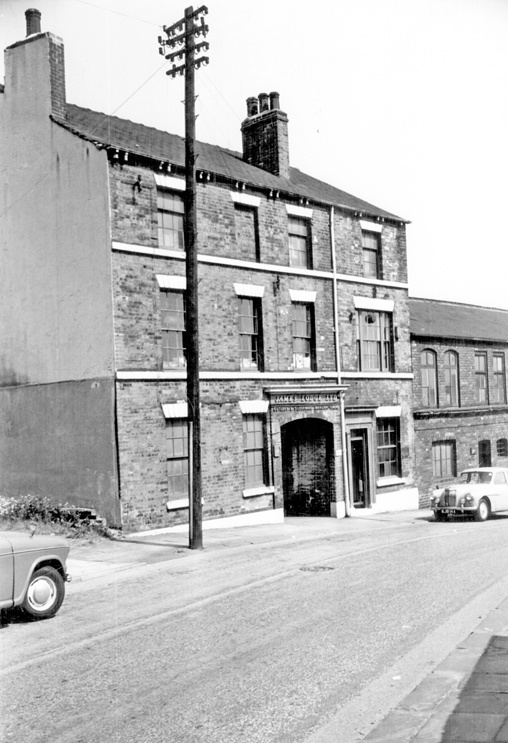
Cambridge Works, Solly Street as later occupied in 1965 by James Lodge Ltd; Picture Sheffield (s19570) © SCC


Francis Townsend (1793-1853) was one of three brothers – the others were Joseph (1797-1843) and John (1800-1838) – who were baptised at Stannington (Presbyterian) Chapel. They were the sons of Joseph (c.1771-1847), a grinder, and his wife, Elizabeth (c.1766-1815). Between about 1828 and 1832, John partnered Robert Hides as a table knife and razor manufacturer at Hollis Croft. (Interestingly, James Townsend had appeared in directories in 1774 and 1787 as spring knife cutler at Hollis Croft) Until his death on 24 May 1838, aged 38, John was listed as a table knife manufacturer at the ‘head of Garden Street’. Joseph was in Garden Street, too, as a table blade grinder. Francis was landlord at The Golden Ball, Broad Lane (though he also worked as a table knife manufacturer). His son, Francis Jun. (1816-1891), became a table knife manufacturer at Hollis Croft.
In 1845, Francis Townsend Jun. advertised at Solly Street as a manufacturer of ‘every description’ of table cutlery, palette, butchers’, shoe knives, and table and butchers’ steels. He employed a dozen men in 1851. His father died at Broad Lane on 4 August 1853. Francis Townsend’s factory in Solly Street (Cambridge Works) was described as ‘extensive’ (Sheffield Independent, 24 August 1864). Townsend’s full-page advertisement in Kelly’s Post Office London Directory (1862) illustrated two factory entrances: one on Edward Street, the other on Solly Street. In reality, Townsend’s workforce was only about twenty, housed in a tenement-type factory, alongside other tradesmen. The multi-storey layout of grinding hulls and workshops, perched on the side of a hill, was cramped and a fire risk. Serious fires occurred in 1872, 1875, and 1906 (Yorkshire Telegraph & Star, 8 September 1906).
In the 1870s, Francis Townsend retired and moved to Worrall. He died at The Grange, Middlewood, on 5 February 1891, aged 74. He left £23,214. Under his son, Francis John Townsend (1840-1917), the firm expanded, with electro-plate and Britannia wares added to the product range. F. J. Townsend told the Census that he employed thirty men and thirteen women in 1871; and thirty workers in 1881. In the early 1880s, the business apparently contracted. Townsend offered for sale a ‘Convenient Works’ in Edward Street, which perhaps represented spare capacity (Sheffield Independent, 19 October 1883). In 1900, he offered another ‘compact’ factory to let (Sheffield Independent, 8 December 1900).
The firm had ceased trading by 1917, when there was a modest auction of hand-forged table and dessert blades, handles, ivory cutting machines, and glazers (Sheffield Daily Telegraph, 20 November 1917). Francis J. Townsend died on 19 December 1917 at Western Bank, leaving £1,567. His press obituary requested: ‘Australian papers please copy’. He was buried at Burngreave, though other members of the family occupy a grave at St Nicholas Church, Bradfield. Townsend’s trade mark was ‘LIFE’: once associated with Samuel Warburton and George Latham); and later with James Farquharson & Sons.