


Charles Pickslay

1828 Advertisement from Blackwell's Sheffield Directory & Guide
Charles Pickslay (1781-1852) was born in Lincoln, the son (according to a descendant, Christopher) of Richard Pickslay (1739-1821) and Penelope Foster (1739-1802). Charles was apprenticed to a Lincoln ironmonger. By 1804, he was an ironmonger in High Street, Sheffield, with John Green. They also began marketing saws and joiner’s tools with James Millington (a partnership that ended in 1811). In 1810, Pickslay married Mary Morton (1782-1857) at Masham. Sheffield General & Commercial Directory (1821) had a fold-out advertisement for Green & Pickslay’s stoves. An old-timer recalled that they ‘were, perhaps, the first and most extensive ironmongers in Yorkshire,’ and that Green ‘was a gentleman fond of field sports and having the entrée of very good houses. But he had to give his great friends long credit, and was not the man to ask for payment, so that the inevitable end resulted, and Mr Green came to poverty’ (Leader, 18761). In 1823, Green & Pickslay was dissolved, though a link between Green and Pickslay remained until 1827. Green died on 11 May 1833, aged 66.
By 1828, Pickslay was involved in two partnerships: the first with Adam Padley, who operated Padley, Norburn & Co; the second with James Appleby and James Bertram (c.1806-1869). At a time when firms rarely advertised, the trio took out a four-page advertisement in The Sheffield Directory and Guide (1828). Above an engraving of Royal York Show Rooms, the company announced itself as ‘Manufacturers to His Majesty and the Royal Family, the Commander-In-Chief, The Lord Chamberlain, etc., etc.’ A lengthy list followed of plate and cutlery (including table knives, spoons, and silver forks), besides chandeliers, writing desks, shooting accessories, fancy buckles, hair and toothbrushes, stove grates, fenders, and locks. Many items were in silver, for which Pickslay had taken out the mark (‘CP’) in 1828.
This puff for what was no more than a High Street ironmonger seems to have been an attempt to ape Joseph Rodgers’ showroom and royal patronage. Thomas Asline Ward sarcastically described it as a ‘flaming advertisement’ and poked fun at the ‘debased Strawberry Hill Gothic’ of the vaunted Show Rooms (Bell, 19102). Ward was a friend of Pickslay and wrote about him in his diary. They joined the local Volunteers together and shared an interest in helping the poor and in various reform projects (such as those relating to elementary schools, the abolition of gin shops, and ending the employment of boy chimney sweeps). Ward evidently had more regard for Pickslay’s militia skills than his business abilities. He believed that Pickslay was too trusting and had a weakness for experimentation and inventing. In the 1820s, Pickslay had corresponded with Michael Faraday about the latter’s experiments in alloying steel with silver and other elements. This led to Pickslay’s speciality: knives, scissors, and razors made from ‘Peruvian Steel’. Some of Pickslay’s ‘Peruvian’ razors and knives have survived, though whether they contained silver, iridium, or rhodium has never been settled.
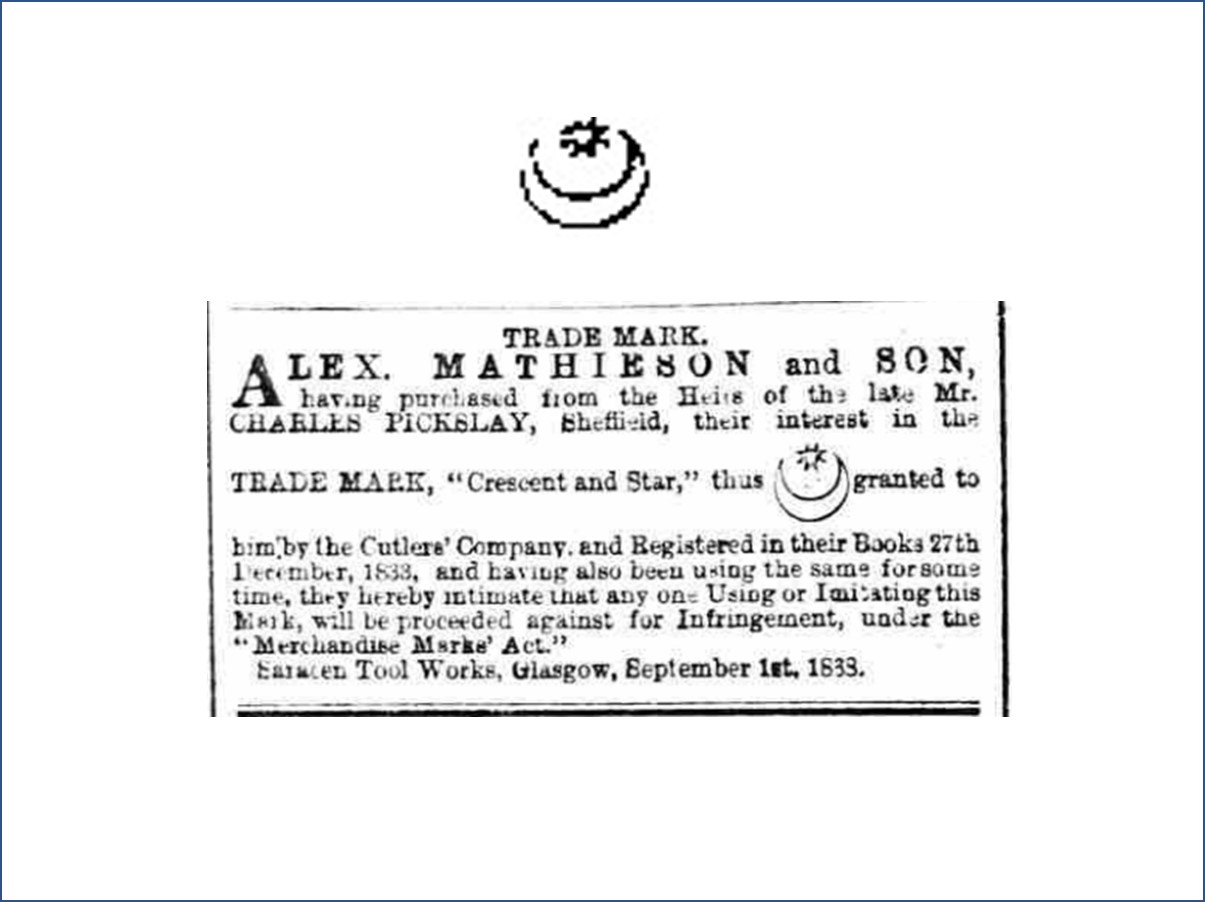
Certainly, Pickslay’s ventures proved short-lived: the partnerships with Padley/Norburn and with Appleby/Bertram ended in 1829. In 1832, Pickslay closed the showroom and auctioned the stock (Sheffield Independent, 22 September 1832). Bertram announced himself as ‘successor’ at Norfolk Street. Pickslay’s premises became the site for the Post Office. In 1833, he launched Charles Pickslay & Co in Solly Street and was granted a Crescent and Star trade mark. In 1837, he opened an office in Cedar/Pearl Street, New York, which was staffed by his son, William Morton Pickslay (1813-1896). But in 1843 Pickslay was bankrupt. He died at his home Endcliffe Cottage on 20 July 1852, aged 71. His burial was at Ecclesall churchyard. His son, William, settled in America. He continued to market ‘Peruvian steel’ table cutlery under his own name (information from Zak Jarvis) and inherited his father’s inventive bent. He registered iron and steel patents and apparently became interested in early American attempts to produce steel in the Adirondacks. None of these ventures proved a great success. By 1860, he was a farmer in Kentucky; and by the 1870s a bookkeeper in Brooklyn. William’s son, Charles Pickslay (1848-1910), later operated a Manhattan jewellery shop at 5th Avenue / 27th Street.
1. Leader, Robert E, Reminiscences of Old Sheffield (Sheffield, 2nd edn 1876)
2. Bell , Alexander B (ed), Peeps into the Past: Being Passages from the Diary of Thomas Asline Ward (Sheffield, 1910)