


James Bramhall & Son

Bramhall trademark, 1787. Image courtesy of Geoff Tweedale
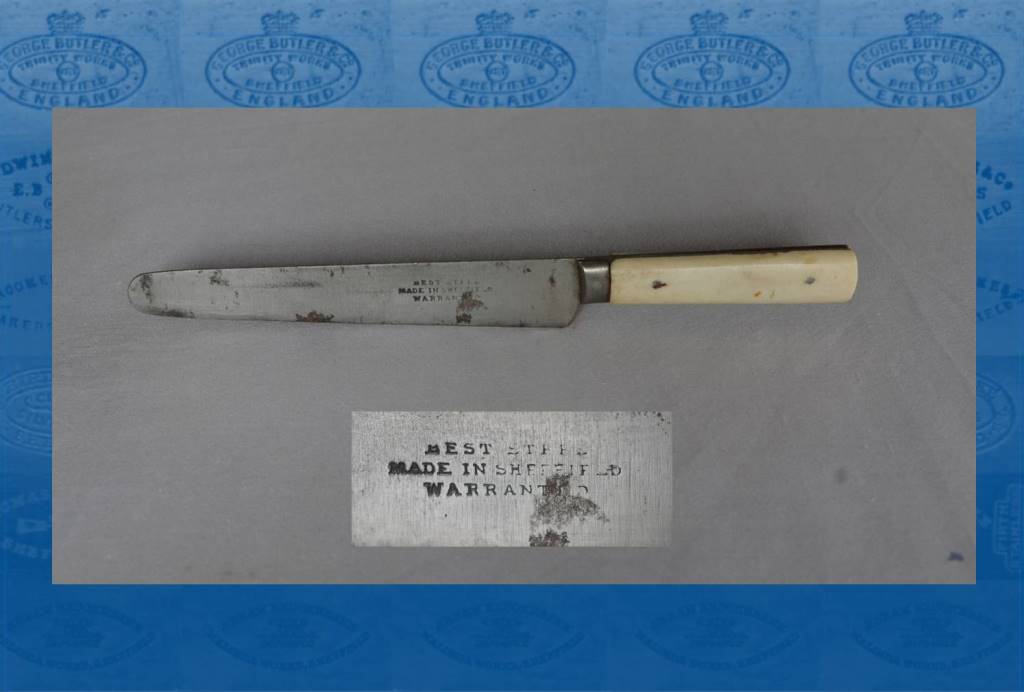
James Bramhall (c.1739-1802) was granted his Freedom in 1761. He was listed in 1774 as a table knife manu-facturer in Burgess Street (trade mark ‘BRAM/HALL’). In 1787, James Bramhall appeared in the local directory as a table knife maker at Portobello (trade mark ‘BEST STEEL’). His son, by his wife Sarah, was James (bapt.1765-1822), who became a Freeman in 1788. In 1797, Bramall [sic] & Son was listed, though two years later James Sen. and James Jun. announced the dissolution of their partnership. The former died in 1802 and was buried at St Paul’s churchyard. At this point, it seems that James Sen.’s other sons – Richard (1772-1822) and Patrick (1778-1824) – began trading as James Bramhall & Sons, cutlers and factors, at Portobello. However, in 1803 they filed for bankruptcy.
By 1811, the local directory recorded that James Bramhall was a merchant and manufacturer of cutlery at Solly Street, Redhill. By 1816, the business was styled ‘& Son’. The son – by his wife, Ann Sykes (1764-1807) – was John Sykes Bramhall (1794-1843). He had been apprenticed to his father. James Bramhall & Son continued to trade at the top end of Solly Street (Red Hill) as a merchant, table knife manufacturer, and general cutlers. James Bramhall opened a trading connection with Bristol. He died there on 27 December 1822 and was buried at St Paul’s, Sheffield. He was aged 57 and was for ‘many years an eminent cutler in this town’ (Sheffield Independent, 21 December 1822). Richard had become a wholesale hardwareman in Manchester and had died in the city on 30 June 1822. His brother, Patrick (who had been granted his Freedom in 1808), died at Bridge Street, Bristol, in 1824 and was buried on 17 November at St Mary-le-Port churchyard.
The Sheffield business passed to John S. Bramhall, who became a Freeman in 1823. In 1827 at Bristol, J. S. Bramhall married Eliza, the only daughter of John Winter. The family lived at Dam House, Crookesmoor. James was a secretary of the Sheffield Shakespeare Club, which had been founded in 1819 to pay convivial homage to the poet and playwright. In 1831, Bramhall’s premises at Solly Street were offered ‘to let’ or for sale. This was part of a permanent move to Bristol, where Bramhall was also running a hardware shop at Bridge Street. However, in 1837 he filed for insolvency in Bristol and sold the house and shop at Bridge Street. He turned to farming by buying first Cote Farm, Westbury-on-Trym, but then moved to Sneed Park Farm, Durdham Down, near Bristol. ‘Agriculture’ was his stated occupation in the 1841 Census. He died at Sneed Park on 21 April 1843, aged 49, and was buried at Holy Trinity church, Westbury-on-Trym. His cutlery marks –‘anchor and diamond’ and ‘anchor and olive leaf’ – were offered for sale in The Sheffield Independent, 19 May 1849.