


John Batt & Company Ltd

Advertisement from Kelly's 1879 Directory
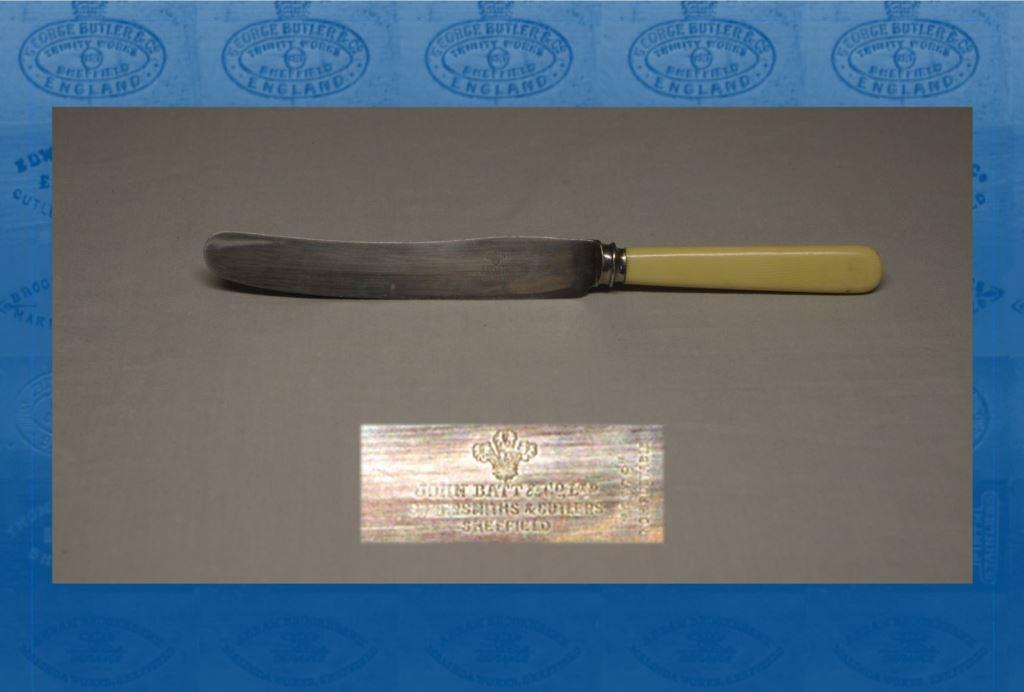

John Batt was born on 10 January 1830, the son of William Batt. Advertisements stated that John founded his silver-plate business in Arundel Street in 1845 (when he would have been fifteen), but a more accurate date would be 1866, when he left his father’s firm. In 1868, John Batt took out a full-page directory advertisement as a manufacturer in Arundel Street and Tudor Place of presentation plate and ‘every description’ of silver-plated table cutlery. He specialised in electro-plated goods, including silver fruit knives, butter knives, dessert knives, and fish carvers. By 1871, the address was Arundel Street, with Batt living in Albert Road, Heeley. By 1876, he had moved his enterprise to Cambridge Street and two years later registered his first silver mark. In 1881, John Batt employed fourteen workers. He died at his residence Studley House, Oakhill Road, on 2 November 1889, aged 59, and was buried in Ecclesall churchyard. He left £3,806. His widow, Hannah neé Cocker, was the daughter of a pioneer in the Sheffield Plate trade. She lived afterwards with her sister. They both died in 1925: Hannah was then aged 96 and her sister 99!
The business passed to Batt’s sons: William Henry Batt (1857-1921?), John Cocker Batt (1860-1909), Horace Nowill Batt (1863-1922), Frederick Edmund Batt (1865-1926), and Bernard Bagshaw Batt (1871-1920). In 1889, Batt’s moved to Park Plate Works, Broad Street (after acquiring George Cutts & Sons). John’s eldest daughter, Mary Willis Batt (1855-1885), had married William, the son of George Cutts. The Century’s Progress (1893) stated that all the firm’s products were made on the premises by a staff of over a hundred. Australia and Canada were amongst the overseas markets. Horace handled the London trade from an office and showroom at 157 Aldersgate Street. In 1896, the firm moved to 14 Sycamore Street (William Batt & Sons was located at No. 17). In 1896, John Batt & Co became ‘Ltd’ with a capital of £6,000. The Batts were joined as directors by Thomas Wilkinson Willis (1855-1937), a Batt trustee and later director of steelmakers Sanderson Bros & Newbould; and by William Sykes (1857-1941), manager of John Smith’s Brewery, Tadcaster. In 1900, the firm registered another silver mark. Other trade marks (listed in Woodhead, 19911) included pictures of a sphinx and bat; a shield device; and ‘FUJI YAMA’ with Mount Fuji and a crane.
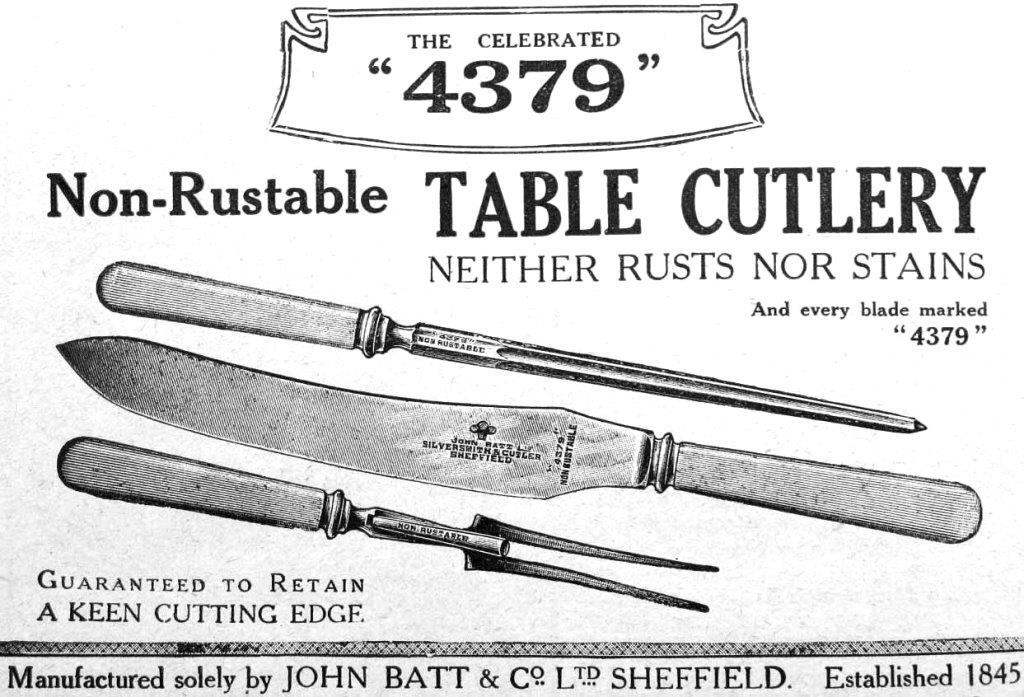
By the turn of the century, John C. Batt was head of the company, with his brother, Frederick, as company secretary. They lived at the same house in Manchester Road. Horace became an insurance broker; and William Henry left the firm. John C. Batt, Rosendale, Cairns Road, Crosspool, died on 29 October 1909, aged 48. He was buried in Ecclesall, leaving £4,267. Frederick and Bernard continued, with Sykes as chairman and Willis as a director. At the end of the War, Batt’s was one of the first to advertise ‘non-rustable’ (stainless) cutlery (Wilson & Twigg, 19192). Bernard B. Batt, Oak Hill Road, Nether Edge, died on 3 October 1919. He was buried in Ecclesall, leaving £2,160. Frederick E. Batt, Ecclesall Road, died on 16 April 1926, aged 60. He left £4,450. John Batt & Co Ltd apparently continued to trade, but it was not listed in a Sheffield directory after 1938.
1. Woodhead, Eileen, Trademarks on Base-Metal Tableware (Ottawa, Canada Parks Service, 1991)
2. Wilson, R T, and Twigg, E J, Industrial Sheffield and Rotherham (London, 1919)