B. Worth & Sons

© Museums Sheffield - china handled table knives from 1913

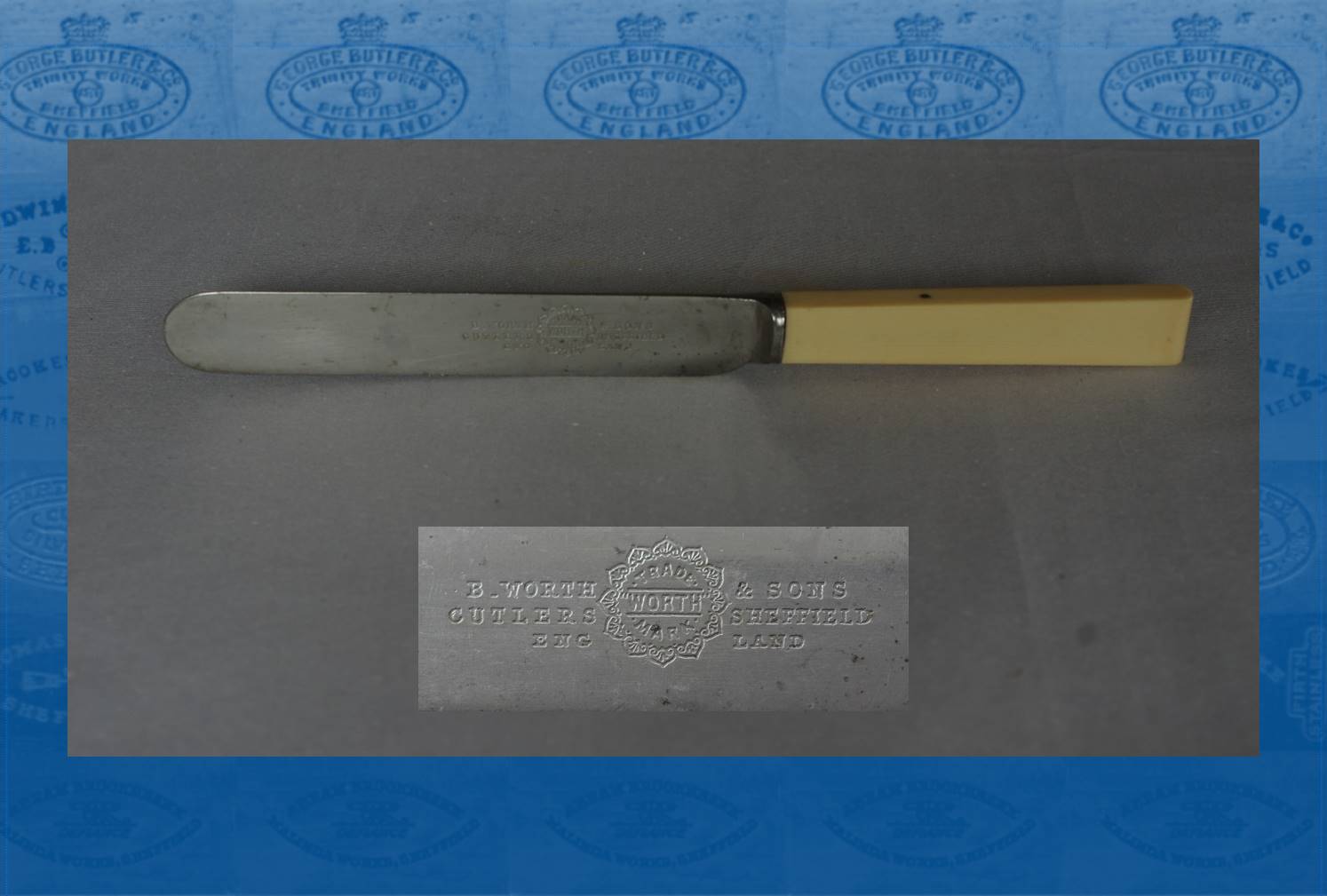
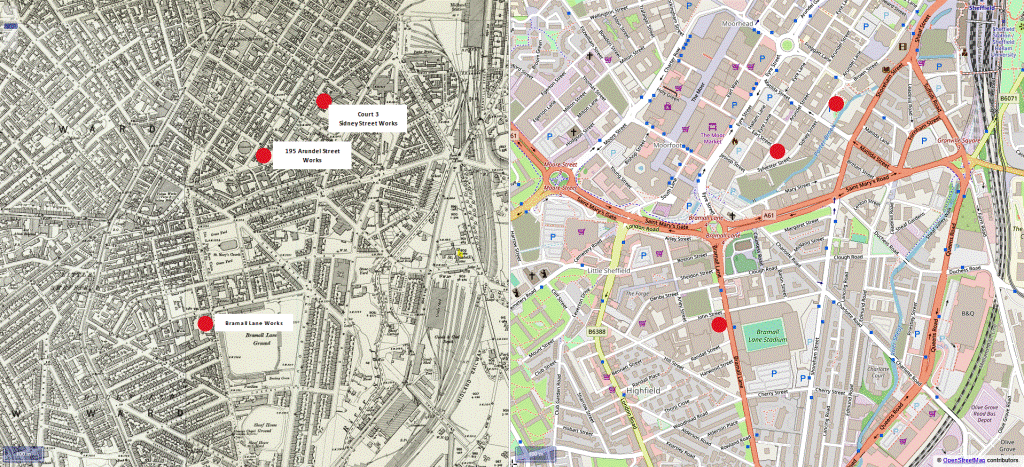
This firm was launched by (William) Beeston Himsworth (1854-1944), who had been born in Sheffield. He was the son of William Himsworth, a razor grinder and shopkeeper, and his wife, Sarah. The family had apparently been involved with the cutlery trade since the early eighteenth century. Beeston learned razor grinding from his father at Rodgers’ Top Wheel, Norfolk Street, and then in 1874 launched B. Worth, registering half his name – ‘WORTH’ – as a trade mark (probably to make it easier to stamp on blades). The firm was based in Bramall Lane as a ‘universal cutlers and comb manufacturers’. By 1884, it was also based in Court 3, Sidney Street, where razors, table knives, Bowies, and butchers’ knives were hand-forged by Himsworth’s workmen. Beeston’s parents left for the USA in about 1877 to demonstrate Sheffield cutlery methods to firms in Connecticut and Massachusetts (though they later returned).
Beeston was joined by his sons, Joseph Beeston Himsworth (1874-1968) and Edwin Himsworth (1879-1948). Joseph had been born on 30 March 1874 at Beeston, Nottinghamshire, where his mother (Hannah Sophia née Goddard) was temporarily living. He joined his father’s firm in about 1888. He took over the silver-plate section (the company registered its first silver mark from Arundel Street in 1889), while Edwin handled razors and pocket knives. In the early days, the American trade had dominated the business, with Worth’s products shipped to its Philadelphia agent, Supple Hardware Co. Amongst the consignments were packs of Barlow knives, which the Himsworths bought from the Furness family in Stannington. The American trade did not last. Joseph recalled how the ‘McKinley Tariff upset our trade with the United States of America for a time and we then turned to other markets, such as South Africa and Australia, adding silver and electro-plate to our business at the same time’ (Himsworth, 19441). The firm began seeking hotel orders. Joseph’s training at the College of Art in designing and using fine materials led to the manufacture of presentation plate, such as shield, cups, and trophies. In 1901, the firm opened a London office. After the First World War, Joseph and Edwin organised an additional business for the Colonial trade, Beeston & Co, which used the ‘MAZEPPA’ mark of Samuel Hancock. The Himsworths had acquired the mark for £250 from Viners.
Joseph always had immense respect for Sheffield working-class craftsmen and never missed any opportunity to learn a manual job from a worker. He wrote with awe of a razor forger he had seen, swinging a hammer many pounds in weight for ten hours a day, 5½ days a week, having walked three miles to work in the morning and three miles home at night. On the other hand, the Himsworths had to adapt to mechanical forging and to stainless steel. Joseph recalled:
"Manufacturing processes in my early days were all dependent upon handicrafts. All our business centred around hand-forged razors, butchers’ knives, spoons and forks and table cutlery. As mass production became the order of the day we had reluctantly to use goffed [machine-forged] blades for medium quality table cutlery. Stainless steel was introduced as war broke out in 1914, and we did a large amount of experimental work on it until it was fully accepted as perfect for use about 1918" (Himsworth, 19441).
The family saw the slow introduction of better wages and living conditions in Sheffield – besides wider international changes, due to the First World War and the rise of Fascism and Communism. Through it all, the Himsworths built up a prosperous business. In his 89th year, Beeston was still active and attributed his health to liberal quantities of linseed tea and Spanish juice, which he downed after racing a grindstone. An unpublished typescript history of the firm (n.d., Hawley Collection) described Beeston and his wife Hannah as ‘bigoted teetotallers’. He died on 7 January 1944, aged 89, and was buried in Walkley Cemetery. He left £2,800. Joseph and Edwin then became the partners, though Edwin died suddenly on 17 December 1948, aged 69. He was buried in Ecclesall, leaving £15,813. Joseph was left to run the family business in Arundel Street.
The Himsworths lived in adjacent houses in Chelsea Road, in the leafy suburb of Nether Edge. But Joseph retained his taste for Sheffield’s Bohemian artistic culture, centred on the local art clubs and craft guilds. He visited the Soviet Union (‘highlight … of my lifetime’, he wrote later) and was sympathetic to the ideas of Edward Carpenter. His only daughter, Joyce Rosemary Himsworth (1905-1990), became a noted silversmith (Bambery, 19782, Conroy, 20083). The British Vegetarian 12 (1970) noted that ‘despite a gentle Jane-Austen appearance, [she] wields a hammer with the best of men’ – though this did not get her a job in the family firm in the 1930s. Joseph’s love of craftsmanship and history led to his presidency of the Hunter Archaeological Society (1956-68) and a book, The Story of Cutlery (1953), which for many years was the only popular work on the subject. His notes for the book, besides an unpublished account of his Russian trip in 1934, are preserved in the Hawley Collection at Kelham Island Museum. He died on 9 May 1968, aged 94 leaving £9,377. B. Worth & Sons had ceased business by the 1960s. Besides ‘WORTH’ and ‘MAZEPPA’, the company trade marks included the word ‘NUNIC’.
His only daughter Joyce Rosemary Himsworth was also a skilled silversmith in her own right, although this was not enough for her to gain a position within the family firm. Joyce kindly donated a large quantity of B. Worth & Sons items to Museums Sheffield in the 1970s.
1. Himsworth, J B, Typescript compiled for the Sheffield Trades Technical Societies (1944), in Sheffield City Library Local Studies
2. Bambery, Anneke (ed), Joyce R Himsworth: Sheffield Silversmith (Sheffield City Museums, 1978)
3. Conroy, Rachel, ‘The Work and Legacy of the Sheffield Artcrafts Guild’, Silver Studies (2008)