Thomas Ward & Sons Ltd

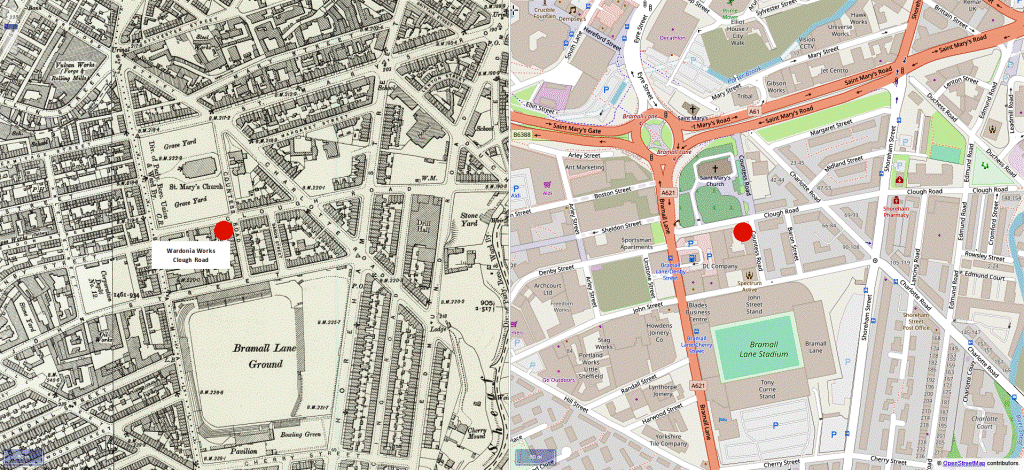
Wardonia Works on the corner of Countess Road and Clough Road, © SCC Picture Sheffield (arc00207)


This company was incorporated in 1925 with £30,000 capital (£21,000 in ordinary shares; and £9,000 in preference shares). The founder was Thomas Watkins Ward (1891-1972), who had been born in Warrington. He was the son of Samuel Thomas Ward (c.1861-1899) – a monumental and stone mason – and his wife, Elizabeth Mary. After Samuel died, aged only 38 (leaving £1,225), his widow continued to live in Warrington. Thomas W. Ward was a milliner in the Census (1911), living in Warrington with his mother, a sister, and three brothers: Percy Douglas (1893-1941), David Harold (1895-1950), and Arthur (1899-?).
The firm had started trading from Suez Street, Warrington. The prospectus of the limited company shows that Thomas Ward & Sons Ltd was a merger between the Wards at Suez Street and William Grant and his sons (Arnold Walter and Cyril), who owned a cutlery factory at Eldon Street and Bishop Street in Sheffield. The first directors were Thomas W. Ward, P. D. Ward, and A. Oldfield (an accountant from Warrington); and William Grant and A. W. Grant (Sheffield Daily Telegraph, 20 March 1925). Evidently, the merger was soon abandoned. After Thomas Ward & Sons Ltd was registered, the business occupied Chaucer Works on the corner of Countess Road and Clough Road, which had previously been occupied by Sheffield Scissors, Razors & Tool Co. Thomas and Harold Ward (as joint-managing directors) renamed the premises Wardonia Works. The company also had showrooms in London and Warrington.
Thomas Ward & Sons was described as ‘cutlery, electro-plate and razor blade manufacturers’. Its trade mark was ‘WARDONIA’, registered in 1924. The firm was a prominent advertiser and issued a ‘Wardonia’ catalogue, which was widely distributed. The company hoped to make money from the newly-emerging market for safety razors with disposable blades. The catalogue also contained several pages of stainless table knives, bread knives, and boxed cutlery canteens (the latter marketed as the ‘Balmoral’ range). Some of the carving knives were hand-ground. Three pages of pocket knives were displayed, including sportsman’s knives in xylo, buffalo, and stag. The pocket knives were marked on the blade ‘1066’, with the same in words beneath (a famous year, but also apparently a steel composition). According to Wardonia razor collector Nigel Sharpe (who has assembled a website on the company, 20131), Ward’s manufactured very little of their shaving items and razor blades. Handles, guards, caps, boxes, shipping boxes, razor-blade wrappers, and razor-blade packets were all bought in from outside suppliers and assembled into sets at Wardonia Works. The knives would also have been contracted to other suppliers.
Ward’s was characteristic of Sheffield firms that tried to break into the mass-market for stainless cutlery and safety razors. The company evidently made money for its owners, but never seems to have taken off as perhaps they intended. Nevertheless, it survived the Second World War (though Percy Douglas Ward died at Lymm, Cheshire, on 26 April 1941, leaving £2,852). His brother, Harold, died, aged 55, in Warrington Hospital on 22 July 1950. He left £21,837. Thomas Watkins Ward, of Whiteley Wood Manor died on 26 April 1972. His estate was valued at £47,174. His company was wound up in 1984. But Wardonia Ltd continued to trade from Union Street, Harthill, near Sheffield, concentrating on cutlery, plate, scissors and penknives. The firm sold razor blades, holders and sets, which continued to be made for Wardonia by outside suppliers. Wardonia Ltd ceased trading in 2000, when T. W. Ward, the son of the founder, retired and relinquished the remaining Wardonia assets. Wardonia Works was later recommended for conservation.
1. Sharpe, Nigel, ‘Wardonia History’ (2013). Posted at: https://wardoniarazors.com/