


William Henry Wragg

William Henry Wragg, 1976. © Ken Hawley Collection Trust - ph.cut.101
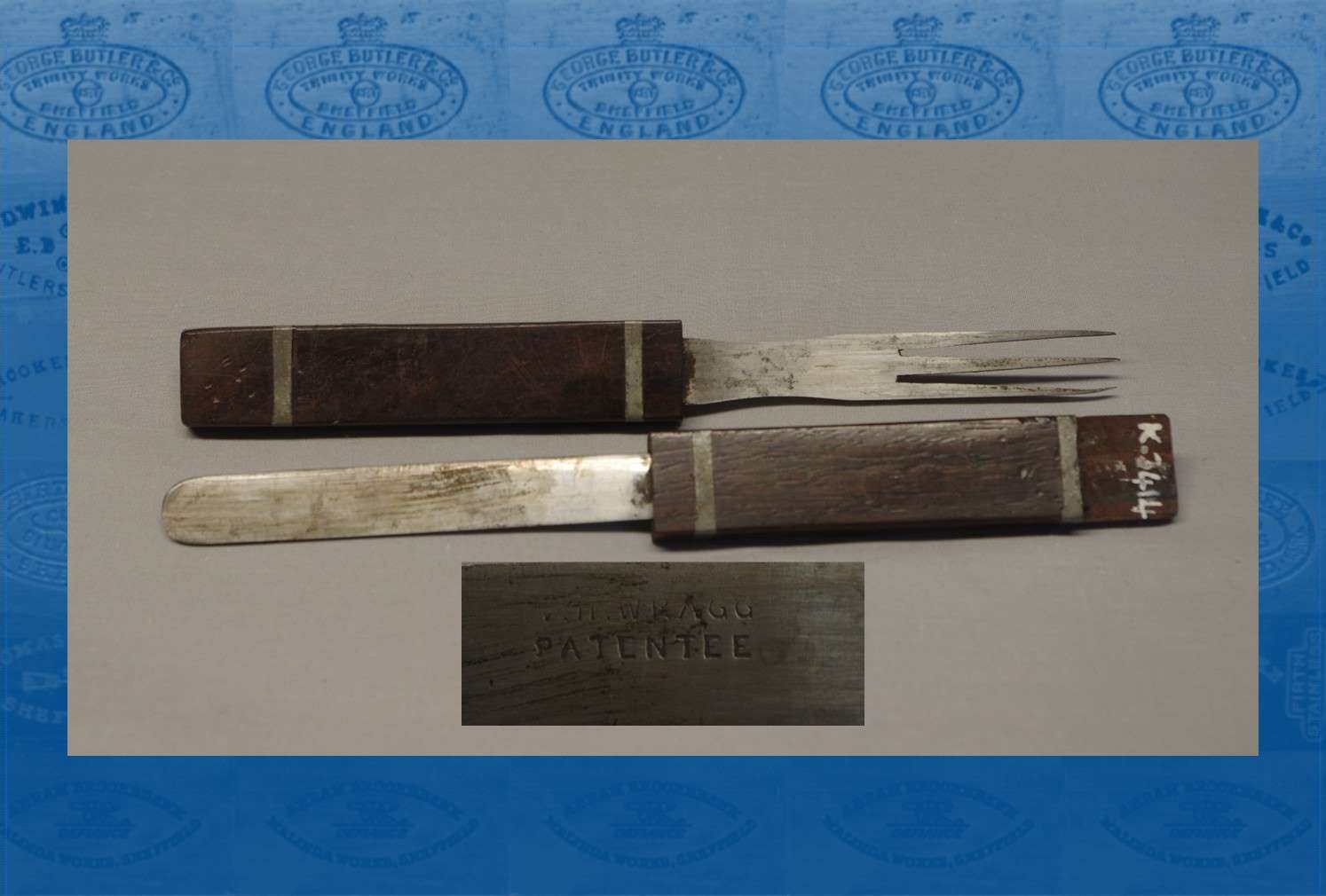
William Henry Wragg (1830-1886) was born in Dronfield, the son of William Henry and his wife, Ann. By 1851, he was working as a spring-knife cutler in Leicester Street. His father was apparently a spring-knife cutler in Solly Street (and formerly a bugler in the 84th Regiment of Foot), who died on 18 March 1868 (aged 71). In 1868, William Henry Jun. partnered William Wright (as Wright & Wragg). In Sheffield Archives, a pattern book of George Wostenholm & Son, shows several high-class Wright & Wragg knives. Wragg himself came to be regarded as ‘probably the best cutler in the trade ... [who] … made the best class of sportsman’s knives, and supplied the leading firms in the town with them’ (Coward, 19191). In 1870, Wragg received an Honourable Mention at the Workmen’s International Exhibition in London. He established his own business in about 1871. Between 1873 and 1894, he operated at Cambridge Street Horn Works and made sportsman’s knives, folding hunting knives, and Bowies. In 1873, he advertised for several ‘steady’ sportsman’s hands (Sheffield Independent, 5 April 1873). He made campaign sets. A trade card for the firm described Wragg as the patentee and manufacturer of the ‘Explorer’s Knife and Tool Roll’ and the ‘Emigrant’s Knife and Tool Roll’. By 1881, he employed seven men and two boys.
William Henry Wragg died at Clinton Place on 8 January 1886, aged 55 (leaving £381). His burial in the General Cemetery was unconsecrated. His sons, Frederick (1854-1939?) and William Henry (c.1859-1923), continued the business. William Henry Wragg Jun. was based at Congo Works, Trippet Lane. The family business was continued in the interwar period by the third generation, as represented by William Henry Wragg, the son of Frederick. The former’s son was Eric Wragg.
1. Coward, H, Reminiscences of Henry Coward (London, 1919)