


Samuel Staniforth Ltd

Samuel Staniforth's works, Carver Street. SCC Picture Sheffield (s44737)
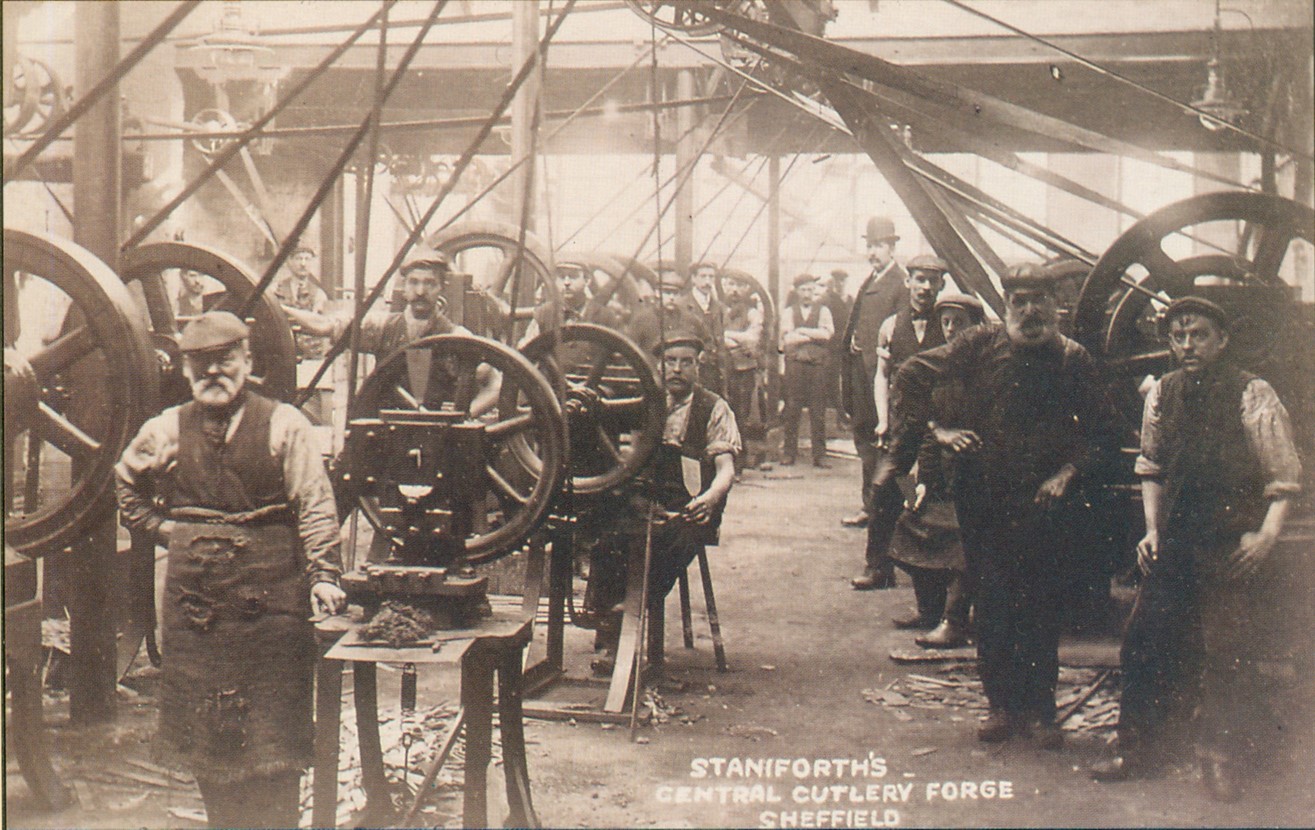
Samuel Staniforth was apparently born in Sheffield in 1840. He may have been the son of Samuel, a pen blade forger in the Park, and his wife, Prudence. Samuel Jun. began business in 1864 at a cutlery forge in Carver Street He manufactured materials for Sheffield cutlers: forged blades, springs, and scales for pen and pocket knives. He was bankrupt in 1867, but was discharged in the following year. He eventually occupied Central Cutlery Forge at 49-51 Carver Street, where in 1880 he installed steam-powered machinery for forging table-knife and butchers’ blades from steel sheet (a process that made hand-forging redundant). In 1881, Staniforth’s workforce was 20 men and eight boys. A photograph of his Forge (c.1900) showed rows of machines – presumably for stamping blade blanks – driven by belts from an overhead central line-shaft. Staniforth at various times also had workshops and forges in Backfields; at Spooner (Rivelin Bridge) Wheel; and Union Wheel in Alma Street – suggesting that he had not entirely abandoned hand-forging. He once described his speciality as ‘double shear blades and fancy shape carvers, shell blades and forks of every description’.
Staniforth’s Forge did not immediately transform the Sheffield cutlery trades – the traditional methods were too embedded – but his factory was a harbinger. It also made him wealthy. He purchased a Victorian house, Glenlea, at 5 Glen Road, in Nether Edge. It has been described as a ‘little Kenwood’, or smaller version of George Wostenholm’s mansion. He retired in 1894 and had his name carved in stone in front of the house, and a fine billiard room, complete with fireplace, built in the grounds in 1896 (Nether Edge Neighbourhood Group, 1987). Staniforth died at Cordwell House, near Holmesfield, Derbyshire, on 30 September 1910, aged 70. After a service at Abbeydale Congregational Church, he was buried, alongside his wife, Tamar Alice (d. 1894, aged 52), in the General Cemetery (Sheffield Daily Telegraph, 5 October 1910). He left £46,272.
After Staniforth’s retirement, the management passed to Tom Merrill Hughes (1865-1932?) and the long-serving Marshall family: William Beaumont Marshall (1872-1951?), Albert Marshall (1874-1932), and Samuel Staniforth Marshall (1881-1942). In 1920, Dickinson’s became part of Cutlery Forgers (Sheffield) Ltd. William B. Marshall retired in 1925. The firm became ‘Ltd’in 1926 (capital £20,000), was wound up in 1927, but resumed trading under Albert and Samuel. During the Second World War, Staniforth’s produced a range of trade and military knives. It remained in Carver Street, but between 1979 and 1999 was acquired by the Osborne family (owners of tobacco knife makers, Arkote). In 1982, the firm moved to Alma Street. In 2000, a management buyout led by Chris Hopkinson purchased Samuel Staniforth Ltd and five years later it relocated to Smithfield Works, Old Lane, Halfway, Sheffield. With over twenty workers and using French steel, in 2022 the company continued to make knives for butchers, cooks, and hunters. It used a ‘BULL’ (picture) trade mark.
