


United Service

© Ken Hawley Collection Trust - K.1666
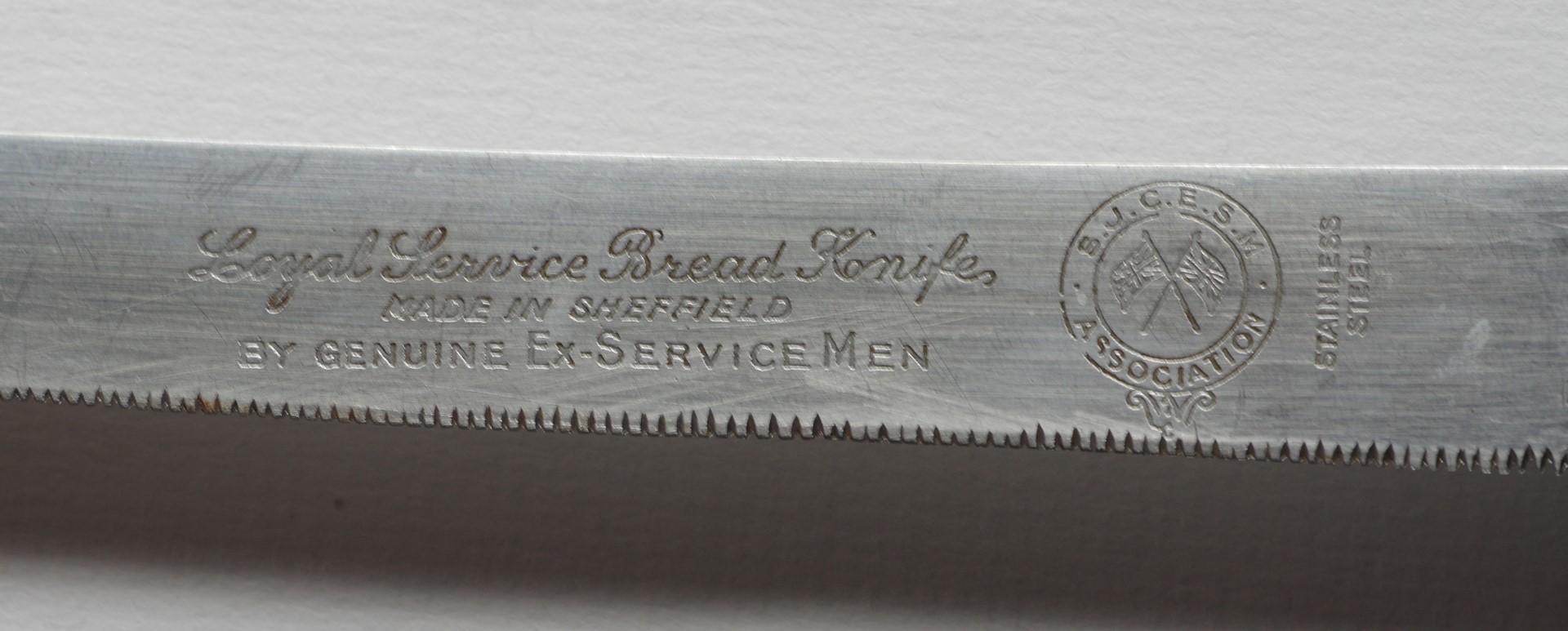
This knife is very similar to other examples in the Collection, one of which carries the inscription ‘Loyal Service Bread Knife, made in Sheffield by genuine ex-service men’ and a logo of the SJCESM Association (see separate entry). We believe that SJCESM stands for the Sheffield Joint Council of Ex-Servicemen.
A number of other knives are illustrated on the internet, mostly items for sale, including a:
- Vintage 1940'S Butter Knife Firth's Stainless made by Ex Service Labour,
- and a large collection of souvenir coronation 1937 items:
A variety of souvenir coronation 1937 cream Bakelite or bone handled butter and fruit knives with Sheffield stainless steel blades, ten in total, three with leather blade covers, different commemorative inscriptions on blades, red and blue stripes to handles, with GRVI and crown embossed in either silver or gold; plus a matching jam spoon and pickle fork, again with cream Bakelite handles and similar decoration as before; a silver plated pickle fork with a plain cream Bakelite handle, embossed in gold ‘Coronation Souvenir May 12 1937’, with profiles of the King and Queen; a large fruit knife with stainless steel blade, with coloured handle in red/orange and black and gilt impressed ‘Crown and GRVI’, marked SJCESM Association – made by Ex-Service Men; and finally a cheese knife with stainless steel blade, cream composite handle and similar decoration to before, with embossed crown and GR in green
There seems to be little detailed information available about the Association although it is strikingly similar to another organisation set up to rehabilitate ex-servicemen, namely Painted Fabrics Limited:
According to a Sheffield Archives Painted Fabrics Research Guide, Painted Fabrics Limited was set up after the First World War by Annie Bindon-Carter, following on from her experiences running painting classes with injured soldiers at the Wharncliffe War Hospital in Sheffield. She became very aware that those with amputations or severe arm and leg injuries were often unable to return to their pre-war work. The company employed injured men and provided accommodation for them and their families. Using specially adapted tools and equipment, the men were taught how to make beautiful hand-painted and printed clothes, curtains and other textiles. These were sold at exhibitions, a few select shops like Liberty’s in London, and to individuals as private commissions.
And…
Painted Fabrics' work was suspended from 1939, the workshops being taken over for the production of aircraft parts during the war and then for a variety of light industrial uses. Fabric production had resumed by 1950 but never again reached the scale achieved in the 1920s and '30s.
Which may refer to the activities of the Association.