


W. Thornhill & Company
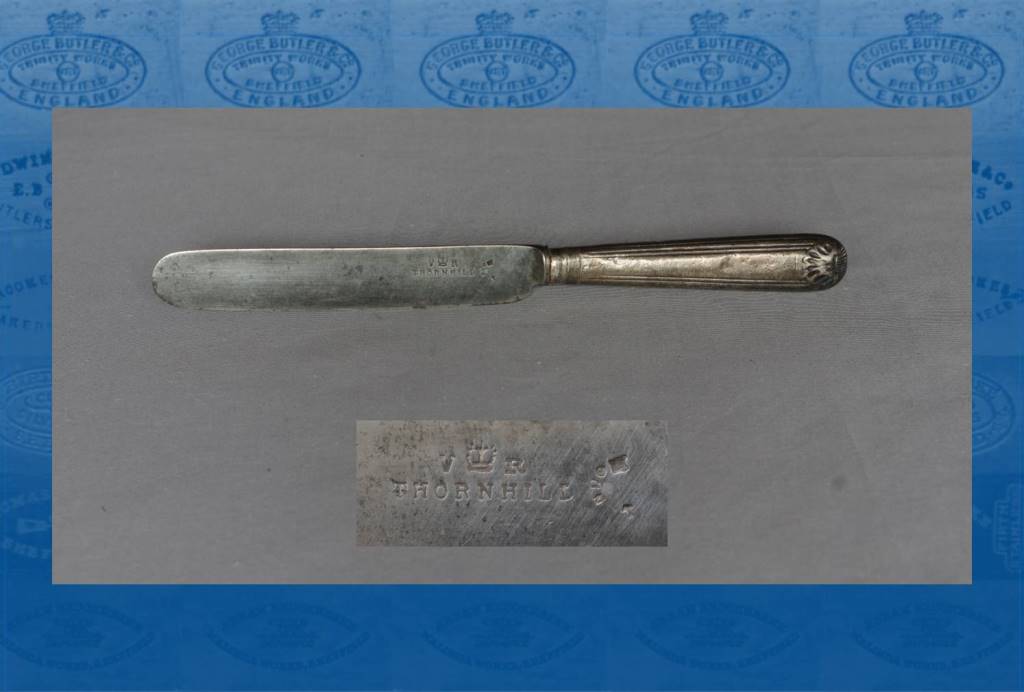
© Ken Hawley Collection Trust - K.1113
This Victorian metal-handled table knife is stamped ‘THORNHILL’, ‘LONDON’, with the Royal Cipher. It was probably made in Sheffield in about the 1890s. Thornhill’s traced its origins to 1734. Its address was New Bond Street, London, where it became a well-known retailer of cutlery and silverware. The owner, Walter Thornhill (1806-1887), had been born at Stoke Newington. He was stationer and rag merchant in the 1840s. In 1851, he was enumerated in the Census as a ‘master cutler’, employing ten men, at 144 New Bond Street. He had married Sophia Turner in 1834 and they had two sons: Edward Baylies (1841-1911) and Hubert (1849-1928).
Walter Thornhill took a particular interest in travelling bags. In 1871, he described himself in the Census as a dressing case manufacturer; and also registered a patent for an ‘improvement’ in travelling bags. His eldest son, Edward, became a civil engineer, so Walter recruited Hubert to partner him in the business. Until 1885, they were joined by Albert Barker. Walter’s business apparently thrived. At his death on 1 May 1887 (aged 80), he left a fortune over £45,000 (worth £4.6m at today’s prices). He was buried at Norwood Cemetery.
Thornhill’s sold a wide range of cutlery – table knives, cutlery canteens, sportsman’s knives, hunting knives – besides dressing cases, jewellery, fancy goods, and silverware. As a retailer, Thornhill’s bought in its stock from makers around the country, but particularly from Sheffield. Atkins Bros and Martin, Hall are known to have been sometimes supplied Thornhill. Hubert took over the running of the firm, though in 1895 (when Thornhill’s registered as a private limited company) his brother and T. Worlock were also listed as directors. The luxury goods market was booming in the 1880s and 1890s, particularly in London. Thornhill opened another branch in Kensington and, armed with its Royal Warrants, advertised regularly in the pages of the leading society journals and newspapers.
However, in 1898 the business was wound up voluntarily, with a reconstruction promised. Perhaps Hubert was a bad manager; or maybe the business was unable to compete with retailers in the metropolis who were also manufacturers (such as Mappin & Webb). In 1905, Thornhill’s was liquidated and the stock sold at knockdown prices. The business lingered for a few years, run by its managers, but by 1912 the shop had been demolished. Hubert retired. When he died on 6 February 1928 at Priory Road, Bedford Park, he left £666.
For a profile of Thornhill & Co, see John Culme, The Directory of Gold and Silversmiths, Jewellers and Allied Traders 1838-1914 (Vol. 1, 1987).