


John J. Bagshawe & Company

Advertisement from 1868 Directory. Image courtesy of Geoff Tweedale.
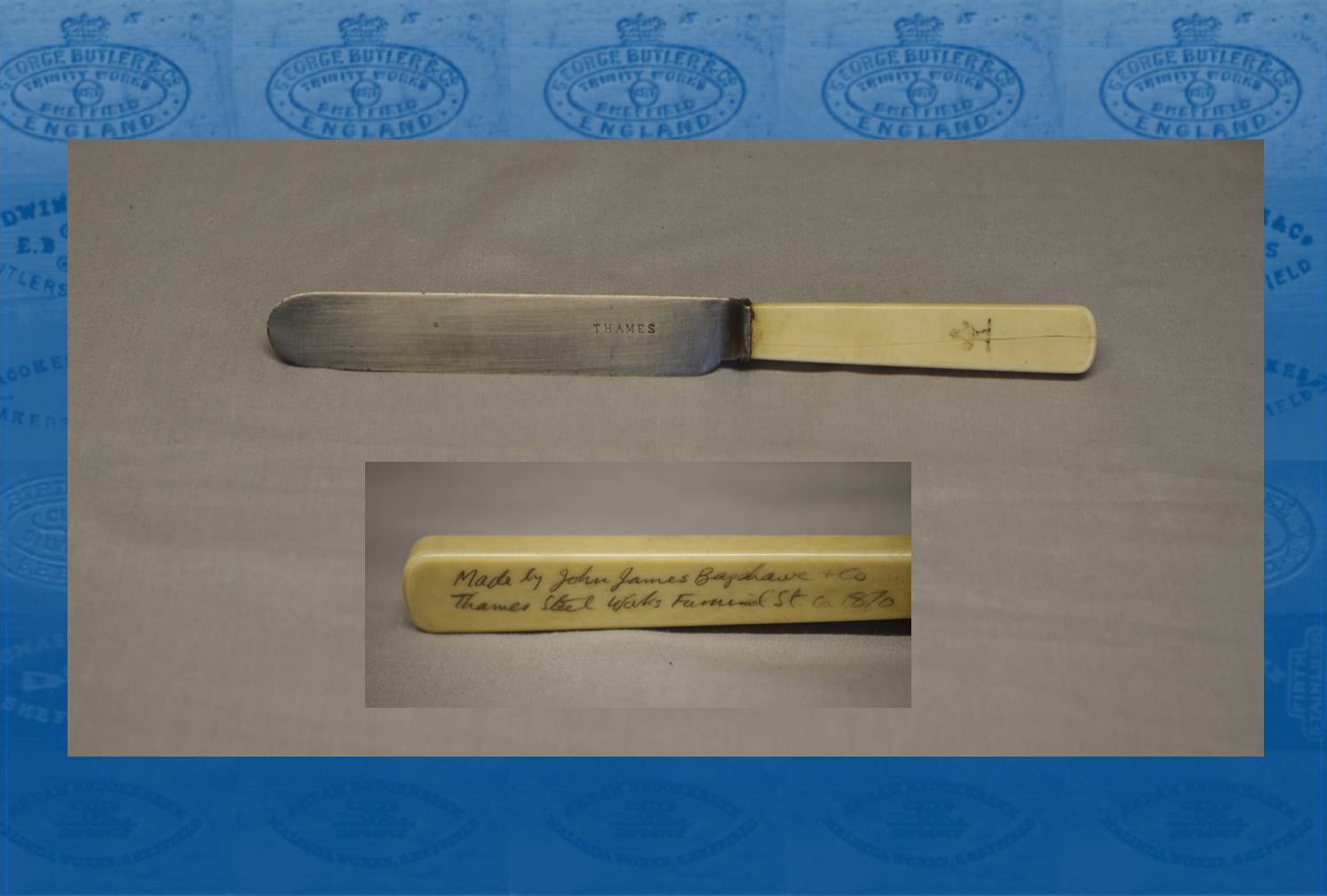
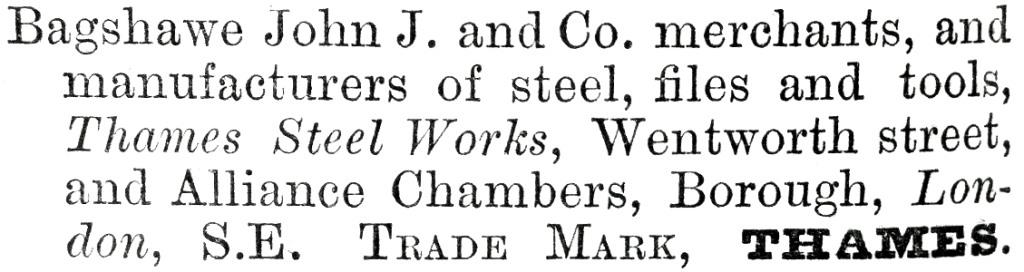
The Hawley Collection has a table knife marked: ‘THAMES’, on the handle of which an anonymous scribe has added: ‘Made by John James Bagshawe & Co, Thames Steel Works, Furnival Street’. John J. Bagshaw (1835-1875) was born in Sheffield, the son of Samuel (a linen draper at Westbar) and his wife, Maria. John became a book agent and then a commercial traveller, probably in the metal trades. In 1861, he described himself in the Census as a steel merchant. In about 1865 (the year he became a member of the Institution of Mechanical Engineers), he launched Thames Steel Works at Wentworth Street. In 1868, he posted an advertisement in the local directory, which mentioned an office in London. His trade mark was ‘THAMES’. Within a year or so, he had moved his manufactory to Arundel Street. It was apparently located near the intersection with Furnival Street and extended down the hill to Arundel Lane. Bagshawe’s was listed as a merchant and manufacturer of steel, files, and tools. Bagshawe acquired a partner: James C. Clark. It is not known whether Thames Steel Works melted steel, but certainly it would have relied upon factoring and outworkers. Bagshawe claimed in 1871 that he employed 130 workpeople.
Bagshawe was an inventor of sorts, registering ‘improvements’ for furnaces for burning or consuming smoke (1866); and for machines for manufacturing semolina and flour (1869). He exported tramways to India and patent lever machines to Egypt for removing rocks from the Nile. He also wrote a letter to The Sheffield Daily Telegraph, 3 December 1869, extolling the virtues of cheap Australian mutton, especially for the working classes and the poor. He also collected English porcelain. He had close contacts with local chemical analysts and with iron manufacturers outside Sheffield. He gifted a papier-mâché tea tray, with a hand-painted scene of the death of Captain Cook, to Henry Bolckow (it is now in the Australian Maritime Museum). In 1868, it was re-ported that Bagshawe had sent circular saws, carving knives, and other cutlery to an exhibition organised by the Ironmasters’ Association, Middleborough. The tools and knives were made from Cleveland pig iron, as a cheaper alternative to traditional Swedish irons (Artizan, 1 May 1868).
These schemes failed to earn a profit and in September 1873 Bagshawe filed for bankruptcy. He had liabilities of £12,000. The sale of the plant in 1874 failed to cover the debts. Court proceedings dragged on until June 1876, leaving many debts unpaid. John J. Bagshawe had died at his residence 33 Broomgrove Road on 1 September 1875, aged 39. He was buried at Ecclesall. He left less than £20.