


J. & J. Beal Ltd

Beal trade marks from Eileen Woodhead - Trademarks on Base-Metal Tableware

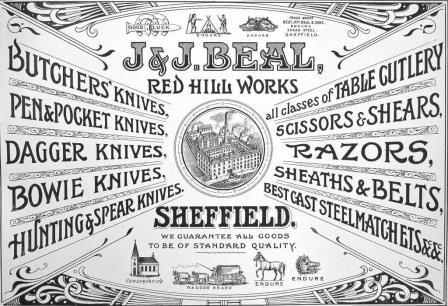
This enterprise began in Ranmoor, where the Beal clan had manufactured scissors since at least the 1790s. According to Stainton (1924)1: ‘[at Water Lane] stood Beal’s factory, the Rand-Moor Cutlery Works, and three cottages, the water for grinding wheels being obtained from one of the many springs which coursed down the steep hillsides. The factory stood on the east side of Water Lane’. The cutlery works, which has been described in detail in Warr (2009)2, was operated by Peter Beal. After his death in 1835, his widow, Sarah (1791-1862), and her manager son, Joseph (1817-1878), continued the business. John Beal – possibly another son – was also involved with J. & J. Beal at this time. He died of typhus fever on 5 December 1846, aged 26. The enterprise went into receivership in 1849 and Sarah and Joseph sold the tools, stock, and their household furniture (Sheffield Independent, 28 July 1849).
After this setback, Sarah borrowed to re-establish the company. In the Census (1851), Sarah Beal (aged 59) was enumerated in Water Lane as a scissors and cutlery manufacturer, employing eight men. Her other son, James Beal (1826-1910), was assisting her as a forger. In 1852, a heated dispute amongst the Beal brothers and others in the family led to a hearing before the magistrates in Sheffield. The parties were bound over to keep the peace (Sheffield Independent, 8 May 1852).
The brothers Joseph and James must have settled their differences, as the directory (1854) listed them as part-ners at Ranmoor Works, manufacturing scissors, butchers’ and shoe knives ‘for exportation’, using the corporate mark ‘ROYAL’. However, property developments were about to swallow the Ranmoor Cutlery Works (Water Lane became Storth Lane) and the brothers gravitated to Sheffield. By 1856, James had established a business under his own name in Dixon’s Yard, Silver Street. In the Census (1861), James was living as a ‘boarder’ (occupation ‘blade forger’) at that address with Mary Ibbotson – the widow of George Ibbotson. In 1862, ‘Joseph Beal & James Beal’ was listed as a butchers’ knife, scissors, and shears manufacturer at Edward Street. In 1868, the brothers’ address was Dixon’s Yard, Silver Street.
In the 1870s, J. & J. Beal’s products were listed as spear point, Bowie, butchers’, bread, shoe, sailors’, hunting, and fancy sheath knives, and butchers’ steels and scissors, etc, ‘for exportation’. The address was Silver Street: however, in 1878 the enterprise began re-locating to Red Hill Works of Horrabin. James Beal had apparently withdrawn as a partner. He had married Mary Ibbotson, though they were to have no sons. James remained involved with the cutlery trades and before his death was lodging in Red Hill as a cutlery manager. He died at Reliance Place on 17 September 1910, aged 84, and was buried in the General Cemetery. He left £142.
Joseph Beal died at Winter Street on 16 October 1878 (aged 61). A friend asked:
whether there is another man possessing the same intimate knowledge of the parish of Sheffield … not only of deceased commercial men of the town, but of previous generations … Besides … a general and intimate knowledge with the early introduction of Methodism in Sheffield (T. O. Hinchcliffe, Sheffield Independent, 24 October 1878).
He was buried at Ecclesall, leaving under £1,500. Ownership of J. & J. Beal passed to his sons: Frederick John Beal (1847-1902), Joseph Ernest Beal (1849-1932), and Arnold James Beal (1852-1926). F. J. Beal relinquished a job as a reporter at The Sheffield Daily Telegraph to re-join the family firm (Sheffield Daily Telegraph, 24 April 1880). He told the Census in 1881 that he was a cutlery manufacturer, employing a hundred men. In 1884, he returned to journalism. He died at Fieldhead Road on 5 May 1902, leaving an estate of £50. He was remembered as a man of ‘much original talent, and in his best days did many smart journalistic feats’ (Sheffield Daily Telegraph, 6 May 1902).
Joseph Ernest Beal and his brother, Arnold James, remained as partners in the business. Industries of Sheffield (1888) stated that the factory covered an acre, with a frontage of nearly 140 feet, three large steam engines, and 350 workers (with others at a workshop in Hollis Croft). The size of the workforce was probably exaggerated. Beal’s was described in White’s Hardware Trade Marks (1892) as ‘Manufacturers of Butchers’, Bowie, Hunting, Table & Pocket Knives, In all Their Branches for Home and Colonial Markets’. Only impressionistic evidence is available on the firm’s export trade, but it was active in northern China and Australia (Sheffield Daily Telegraph, 17 April 1878). The main trade mark was ‘ENDURE’, which had various accompanying illustrations: a boar’s head, natives around a cooking pot, and a horse. Other marks were ‘CONSERVATIVE’ (with a church), formerly used by Edward Keeler; ‘GOOD LUCK’ (with two horseshoes); and ‘WAGGON BRAND’ (with a wagon and horses).
Red Hill Works was a typical three-storey tenement factory, which fronted Red Hill and at the rear overlooked the top of Garden Street. The factory occasionally featured in the local press, though mainly because it was prone to fires and industrial accidents (some fatal). The resulting newspaper reports provide some insight into working conditions at Beal’s. On one occasion, an 18-year-old grinder of cane knives, John William Wheatcroft, died after he became entangled in belting. He was ‘whirled round the shaft and horribly crushed and mutilated’ (Sheffield Independent, 20 June 1888). Another worker (Ernest Riley) suffered an almost identical ‘whirl’ around the shafting. His right foot was torn off and his leg had to be amputated above the knee; his left leg was broken; and he lost the end of a finger (Sheffield Independent, 7 January 1915. Incredibly, he survived and returned to work as a buffer.
In 1900, a fire damaged Red Hill Works and its Garden Street workshops, when The Sheffield Independent (12 March 1900) claimed that the firm employed 500 workers (including 200 forgers, finishers, and grinders). A strike in 1913 – triggered by the Beal family refusing to pay a locally agreed pay rise to their cutlers and grinders – provided further employment details. The union walk-out involved 64 grinders (from a company total of a hundred), 83 cutlers, and fourteen others. The strike was soon settled (Sheffield Independent, 10 January 1914).
After the First World War, Beal’s declined steadily, as the older generation passed out of the business. Frank Angwin Beal (1895-?) – who was A. J. Beal’s son – joined the firm in the 1920s; but his brother, Arnold James Beal (1895-1917), had died in the War. Arnold James Beal died on 2 August 1926 at 44 Cliffe Road, Ranmoor, and left £12,160. A Conservative and Wesleyan, he was buried at Fulwood. Joseph Ernest Beal died on 25 July 1932 at his home, Stand House, Fulwood Road. He was a local Conservative Party chairman and a JP. His burial was also at Fulwood. He left £37,196. His eldest son, Julian E. Beal, had died on 28 November 1927, aged 53. He had been connected with the firm all his working life, as a departmental head and traveller.
An obituary of J. E. Beal: noted: ‘Time was when the firm did a large American and Continental business. But big tariffs hurt them, and latterly their chief trade has been in the home and Colonial markets’ (Sheffield Daily Telegraph, 26 July 1932). The company sold parangs and pruning knives in Malaya and the East Indies; and also exported cane knives and machetes. Cutlers’ Hall has several Eastern and Colonial-style Beal display knives (Tweedale, 19963).
Beal’s became a private limited company in 1938, with £5,000 capital and Frank Angwin Beal and his wife, Lilian K. Beal, as directors. In 1939, there was yet another fire at Red Hill Works, when the first and second floors were destroyed (Sheffield Daily Telegraph, 29 June 1939). The firm employed only about a hundred workers and was already relocating to premises at Corporation Street. In 1939, Frank Beal was visiting Canada and the USA. By 1943, the business had been acquired by Neepsend Steel & Tool Corporation in Sheffield. Its chairman was Sir Stuart Goodwin. (The latter became a noted benefactor to Cutlers’ Hall and perhaps that is how those Beal knives entered its collection.) Frank A. Beal apparently became a sales director of a tractor company and worked in Canada. In 1956, Beal’s became part of Ralph Martindale & Co, the machete makers of Birmingham (which also acquired Kitchin).
1. Stainton, J H, The Making of Sheffield, 1865-1914 (Sheffield, 1924)
2. Warr, Peter, The Growth of Ranmoor, Hangingwater and Nether Green (Sheffield, 2009)
3. Tweedale, G, The Sheffield Knife Book: A History and Collectors’ Guide (Sheffield, 1996)