


James Burnand & Sons

Advertisement from 1895. Image courtesy of Geoff Tweedale
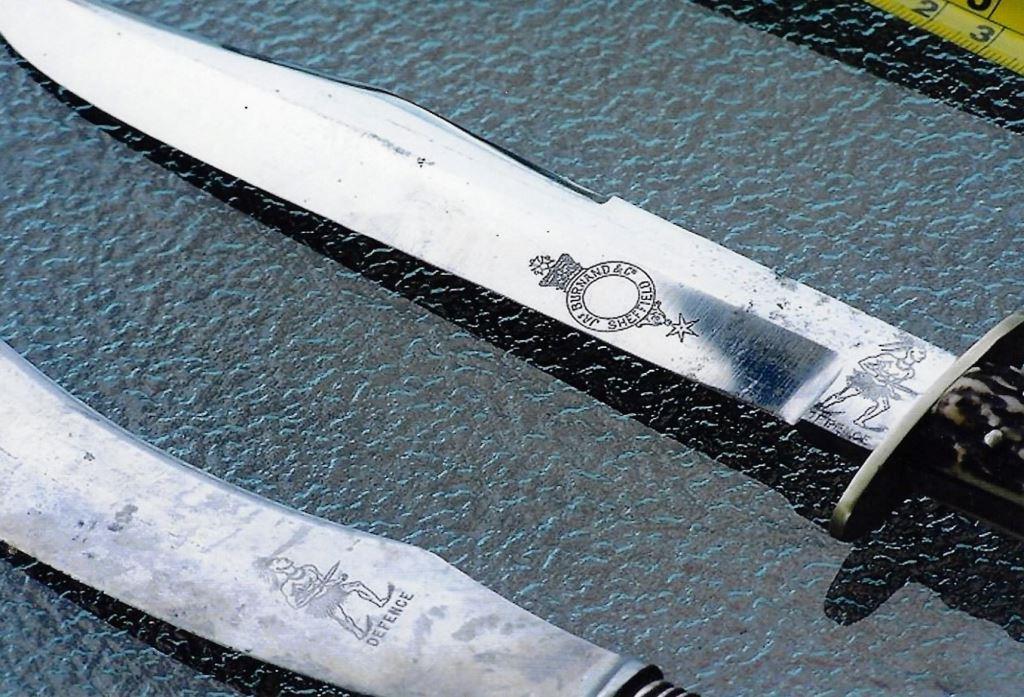
This business was founded in 1850 by James Burnand (1820-1890), who had been born in Sheffield on 1 February 1820, the son of James Burnand, yeoman, and his wife, Isabella. In 1849, he was listed as a fluter and hafter in Rockingham Street. The Census (1851) enumerated him as a plater and hafter, employing two apprentices. In the early 1850s he continued in Rockingham Street and by the end of the decade was involved in the manufacture of Bowie knives. An 1863 directory advertisement has James Burnand & Sons, Netherthorpe Street, as a manufacturer of a ‘silver and plated desserts’ and a wide range of table cutlery (including ‘pic-nic’ or camp cases) and Bowie knives, dagger knives, and ‘lion slayers’. Butchers’ knives and steels, ‘suitable for South America, River Plate, India, and other markets’, were also made. The trade mark was a picture of an Indian brave above the words ‘SELF DEFENCE’. Another mark guaranteed ‘BEST STEEL’ for ‘good cutting quality’; and ‘Q’ within a shield was also registered.
The Census (1871) recorded that James employed six workmen and lived in Upper Hanover Street. The firm was based at Suffolk Street (later Sudbury Street), off Meadow Street, then Leicester Street Works, off St Philip’s Road, Netherthorpe. Burnand exhibited at the Workmen’s International Exhibition in London, 1870. He also won medals at the Philadelphia Centennial Exhibition in 1876 and the South African International Exhibition in Cape Town in 1877. His showcase of dagger and hunting knives for Philadelphia was described in The Sheffield Independent, 29 March 1876:
There are blades of almost every conceivable shape, from the ‘happy dispatch’ knife used in Japan to the straight blade in vogue to the Russian students and the dwarfed inhabitants of the Polar regions. The latter are all beautifully chased, and have dainty pearl, carved ivory, or peculiar tup-horn handles, and look – no doubt it is only appearance – singularly harmless by the side of the plain curved blades and repulsive black hafts of the Japanese weapons. Many of the handles are mounted with solid silver, and the sheaths of others are embellished with gilt. Hunting knives are there in almost every variety, and some of the most unique designs that can be imagined. A number of these were made for presentation to the Ashantees; but the negotiations between the Government and the Sheffield firm fell through, and the savage Africans had to be content with the more ornamental, but less useful medals. On these knives various national emblems are richly chased or etched, and the mounting of all of them is superb. The remainder of the case contains sportsmen’s knives, bowie knives, and superior table cutlery, all of which are certain to arrest the attention of practical men.
James Burnand prospered, though his business remained small – employing five workers in 1881. He had several workshops in his garden, plus the premises at Leicester Street, alongside dwellings in Fitzalan Street. In 1882, he bought Ashland House, Nether Edge, for £1,175. He sold that residence in 1888 and in the following summer announced his retirement in favour of his sons. According to descendant Mick Dowse (2001), James and his wife Mary Ann née Wharton had ten children. (He also adopted a son named Percy, who was not involved with the firm, but apparently later launched Burnand, Booth & Co.) James’s sons Benjamin, Edwin, Henry, and James had shares in the business. James Burnand died at his residence in Kenbourne Road, Nether Edge, on 4 March 1890, aged 70. He left £4,935 and was buried in Ecclesall. Much of his property was left to his spinster daughters, Emma Eliza and Clara Ellen. To ease their cash flow problems, his sons eventually had to buy back these assets. After 1890, James’s eldest son Benjamin Wharton Burnand (1840-1927) became the head of the firm, which continued to specialise in daggers and Bowie knives.
Edwin died in 1918. After the First World War, the partners were Benjamin W. Burnand, Camm Street, and Henry Burnand (1849-1929), Crookesmoor Road. Benjamin died in Gloucester in 1927 and was buried in Gloucester Old Cemetery. Henry died in Sheffield Infirmary on 29 September 1929, aged 79, leaving £112. The firm ceased trading. Drawings of Bowie and hunting knives made by Burnand are featured in a pattern book amongst the George Wostenholm records in Sheffield Archives (suggesting that Wostenholm sourced knives from Burnand or acquired its assets).